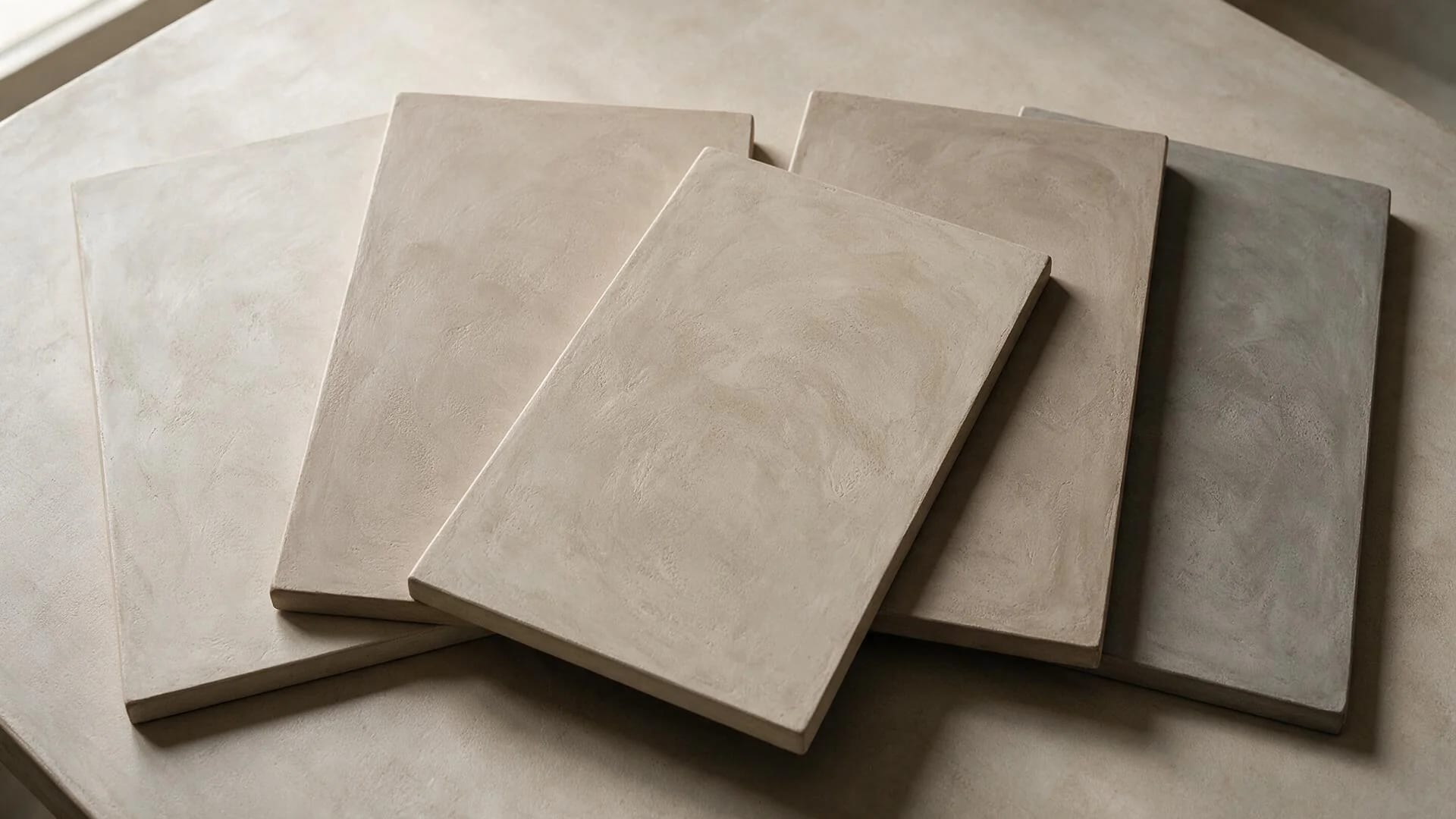
Short answer
No. “Microcement” is a category word, not a specification. It covers three different binder chemistries — acrylic-cement, epoxy-modified, and polyurethane-mineral — that flex, wear, hold color, and handle water very differently. The only reliable way to know which one you are buying is to read the technical data sheet and ask what chemistry lives in each layer. ATRIA's PURO system is the documented polyurethane-mineral tier.
A quick note from me before you read this
It is the question I am asked more than any other, and almost always the same way: "Isn't all microcement basically the same thing?"
The honest answer is no — and it is not close. "Microcement" is a category word, the way "wine" or "leather" is a category word. It tells you roughly what something is. It tells you almost nothing about how it will behave on your floor in five years.
Underneath that single word sit at least three genuinely different binder chemistries. They flex differently, they wear differently, they hold color differently under sunlight, and they behave differently in a wet room. Two products can both be labeled "microcement," sit side by side on a shelf, and share almost nothing on their technical data sheets.
So this is the page I point people to first. It explains what actually separates one microcement from another, how to read that difference for yourself on a TDS, and — once you understand the categories — where our PURO system sits and why I am comfortable being specific about it. Every section links out to a deeper guide if you want to keep reading.
So what actually differs between microcement systems?
The single most useful thing a buyer can learn is that the word "microcement" describes a format — a thin, seamless, trowel-applied mineral coating — not a formula. The format is shared. The binder chemistry holding it together is not, and that is where the performance lives.
There are three binder families you will run into:
Acrylic-cement microcement
An acrylic polymer mixed with cement. It is the most common entry-level system and the easiest to apply. It can look lovely on day one. The trade-offs show up over time: acrylic binders are more rigid, so they are less forgiving of substrate movement, and the budget acrylic topcoats often paired with them can dull or chalk after a few years in a sunlit room.
Epoxy-modified microcement
Here epoxy resin does the binding, or a clear epoxy is used as an aggressive topcoat. Epoxy is hard and chemically resistant — genuinely useful in industrial settings — but it tends to be brittle at the edges and is well known to amber under UV. These systems are real, and they are frequently sold under the same "microcement" label — which is exactly why reading the technical data sheet matters.
Polyurethane-mineral microcement
A modified polyurethane resin bound with a selected mineral aggregate. Polyurethane is the same elastomeric polymer used in running-shoe midsoles and automotive suspension bushings because it bonds tightly while still flexing with whatever it is bonded to. Paired with a hard mineral aggregate and a UV-stable polyurethane topcoat, this is the premium decorative tier — and it is the family our PURO system belongs to. You can see the complete layered system, TDS numbers included, on our polyurethane microcement page.
If you want the full chemistry deep-dive on why these three behave so differently, I wrote a separate piece on exactly that: the best polyurethane microcement — why formulation matters more than brand.
The three microcement chemistries at a glance
Same format, three different formulas. This is the difference the word “microcement” hides:
| Factor | Acrylic-cement | Epoxy-modified | Polyurethane-mineral (PURO) |
|---|---|---|---|
| Binder | Acrylic polymer with cement | Epoxy resin as binder or aggressive topcoat | Modified polyurethane resin in aqueous emulsion |
| Aggregate & hardness | Standard cement fillers | Varies by formulation | Quartz, marble sand & Etna volcanic mineral — 32 ± 2 MPa compressive at 28 days (EN 1015-11) |
| Flexibility | More rigid; less forgiving of substrate movement | Hard but brittle at edges | Hard-elastic film that flexes with the substrate |
| UV / yellowing | Budget acrylic topcoats can dull or chalk | Prone to ambering under UV | Polyurethane topcoat specified non-yellowing & UV-resistant |
| Wet areas | Depends on the system | Depends on the system | Used over a waterproofing membrane; topcoat tested to ISO 22196:2011 |
| Typical positioning | Entry-level | Industrial-leaning | Premium decorative tier (ATRIA PURO) |
How do you tell them apart? Read the TDS, not the brochure
You do not need to be a chemist to sort this out. You need one document and one line on it.
Ask for the current technical data sheet (TDS) of any microcement you are considering, and find the "Chemical Nature" line for two layers: the decorative coat and the topcoat. That single line tells you which of the three families you are actually buying.
For our SuperTitanium BC, that line reads "modified polyurethane resins in aqueous emulsion." If the same line on another product reads "acrylic" or "epoxy resin," you are no longer comparing the same thing — and you now know which trade-offs come with it.
If the sheet is hard to get, ask again until you have it. Any established manufacturer publishes the binder chemistry of its own product — it is not a trade secret. For a structured, side-by-side method — including the exact questions to ask — see how to compare microcement systems by TDS and the ATRIA microcement system layers explained.
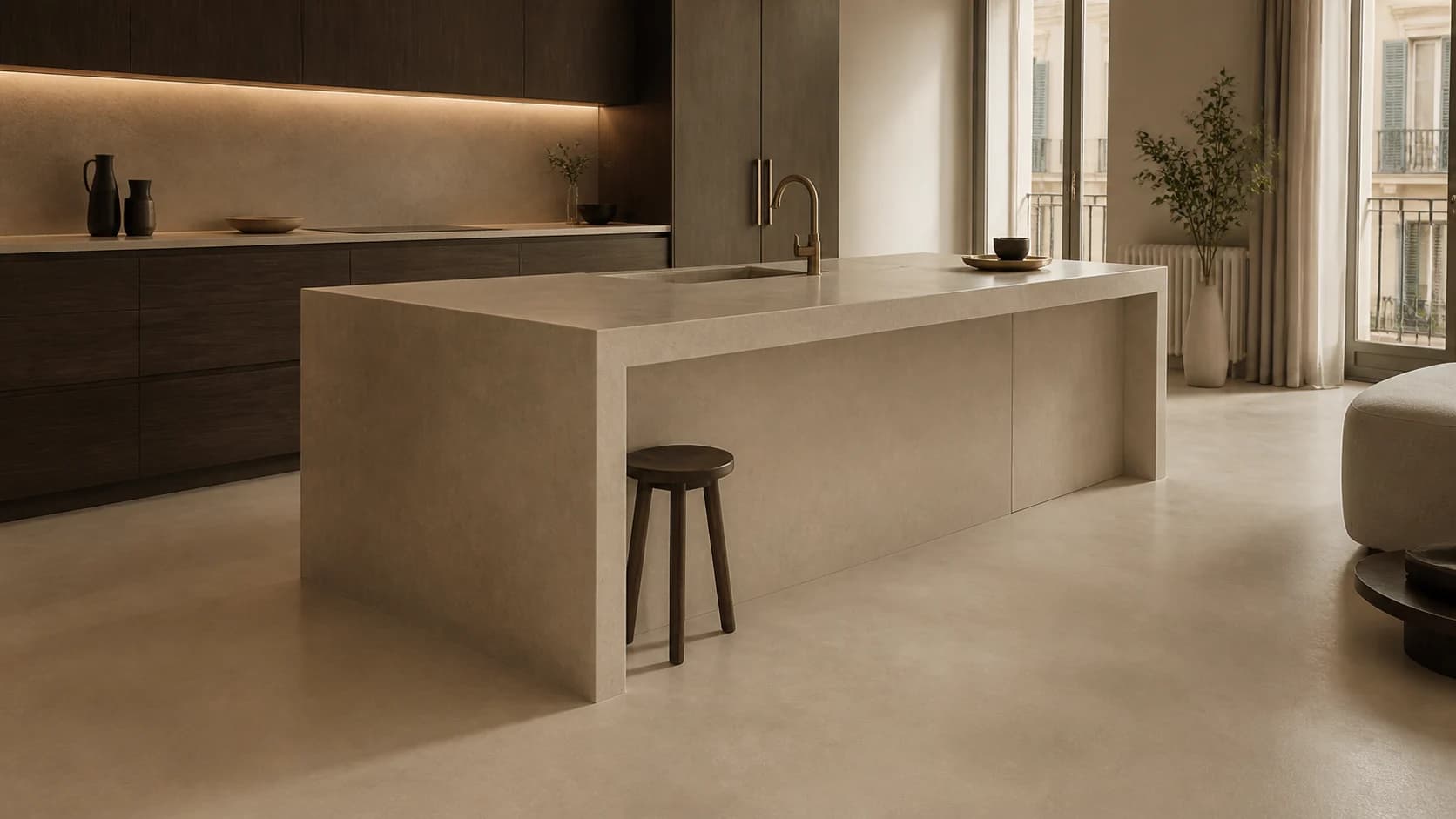
Where ATRIA's PURO system sits — and why I'll be specific
Now that the categories are clear, I can be precise about what we make.
ATRIA PURO is a polyurethane-mineral system, manufactured by Colorificio Atria in Partanna, Sicily, where the company has been making decorative finishes since 1968. The flagship decorative coat, SuperTitanium BC, is a two-component modified polyurethane resin in aqueous emulsion, bound with a quartz, marble sand, and Etna volcanic mineral blend. Each mineral earns its place: quartz brings hardness and abrasion resistance, marble sand adds brightness and a refined character, and the Etna volcanic mineral contributes density and mechanical interlock.
The numbers on the SuperTitanium BC technical data sheet are the part I am proudest of, because they are measured, not marketed:
- Compressive strength 32 ± 2 MPa at 28 days (EN 1015-11)
- Adhesion on concrete above 3–3.5 MPa after 7 days; ASTM D4541 adhesion above 2.5 N/mm²
- Shore D hardness above 65
- Service temperature −10°C to +120°C
- A hard-elastic, closed-pore cured film that limits dirt absorption and cleans easily
Over that decorative coat goes New Atriapol Antibacterial, a two-component polyurethane topcoat that is specified as non-yellowing and UV-resistant and is tested to ISO 22196:2011 for antibacterial performance (against E. coli and Staphylococcus aureus), with EN 1542 adhesion above 3.6 MPa.
Here is the distinction I will put my name to: ATRIA PURO carries polyurethane in the decorative microcement layer itself — not just in the topcoat — and no microcement system we have verified, TDS in hand, does the same. Many systems marketed as "polyurethane microcement" put the polyurethane only in the sealer on top. Ours runs through the finish. Ask any supplier to show you the same, layer by layer, in their TDS. That is the whole point of the system, and it is why I am happy to publish every number above.
What about wet areas and yellowing — the two questions that follow
Once people accept that microcement systems differ, two practical questions always come next.
Is microcement waterproof?
Installed correctly, an ATRIA microcement shower or wet room is a waterproof system. The build starts with a code-compliant waterproofing membrane or liquid-applied waterproofing layer; the microcement system — primer, reinforcement where needed, SuperTitanium BC decorative coats, and the closed-pore, anti-absorbent New Atriapol Antibacterial polyurethane topcoat — is installed over it. Built that way, the finished assembly is waterproof and fully suitable for showers, tub surrounds, spas, and steam rooms, with no grout lines to fail. The waterproofing is delivered by the membrane within the assembly — the decorative coating itself is not a standalone membrane, which is exactly why a proper waterproofing layer always goes underneath it. The full method is here: can microcement be used in showers?
Correct installation is the other half of the answer — the best chemistry in the world only performs when the layers go down right. That build discipline is exactly what our hands-on microcement training in Dallas certifies installers on, layer by layer, on this same system.
Does it yellow?
Only if the topcoat chemistry invites it to. Epoxy and aromatic-polyurethane topcoats are more prone to ambering under UV; a UV-stable aliphatic polyurethane topcoat resists it. Our Atriapol topcoat is specified as non-yellowing and UV-resistant for exactly this reason. The chemistry behind that is its own article: does microcement yellow? the chemistry behind the answer.
So — is all microcement the same?
No. The word is a category, not a guarantee. Underneath it are three binder chemistries that age very differently, and the only reliable way to know which one you are buying is to read the technical data sheet and ask what chemistry lives in each layer.
That is not a reason to be nervous about microcement. It is a reason to choose a system that can show its paperwork. Ours can — from the quartz, marble sand, and Etna volcanic mineral in the decorative coat to the ISO-tested antibacterial topcoat sealing it.
Frequently asked questions
Is all microcement the same?
No. "Microcement" is a category word, not a single specification. It covers at least three different binder chemistries — acrylic-cement, epoxy-modified, and polyurethane-mineral — and they perform very differently on flexibility, abrasion, UV stability, and wet-area service. The chemistry on the TDS is what decides how the finish behaves, not the word on the label.
What are the different types of microcement?
Three common binder families: acrylic-cement (acrylic polymer with cement, the entry-level system), epoxy-modified (epoxy as the binder or an aggressive topcoat), and polyurethane-mineral (a modified polyurethane resin with a selected mineral aggregate — the premium decorative tier that ATRIA PURO belongs to).
How can I tell which type of microcement I am being quoted?
Ask for the current technical data sheet and read the "Chemical Nature" line for both the decorative coat and the topcoat. ATRIA’s SuperTitanium BC reads "modified polyurethane resins in aqueous emulsion." If the same line on another product reads "acrylic" or "epoxy resin," it is a different chemistry — and a manufacturer will publish that line on request.
What kind of microcement is ATRIA PURO?
A polyurethane-mineral system. SuperTitanium BC is a two-component modified polyurethane resin in aqueous emulsion bound with quartz, marble sand, and Etna volcanic mineral. Its TDS lists 32 ± 2 MPa compressive strength at 28 days (EN 1015-11), Shore D hardness above 65, and a −10°C to +120°C range. It is sealed with New Atriapol Antibacterial, a two-component polyurethane topcoat tested to ISO 22196:2011.
Is microcement waterproof?
Yes — installed correctly, an ATRIA microcement shower is a waterproof system. The build starts with a code-compliant waterproofing membrane or liquid-applied waterproofing layer, and the microcement system is installed over it, sealed with the closed-pore New Atriapol Antibacterial polyurethane topcoat. Built that way the finished assembly is waterproof and fully suitable for showers, tub surrounds, spas, and steam rooms, with no grout lines to fail. The waterproofing is delivered by the membrane within the assembly — the decorative coating itself is not a standalone membrane, so a proper waterproofing layer always goes underneath it.
Does all microcement yellow over time?
No — yellowing depends on the topcoat chemistry, not on the word microcement. Epoxy and aromatic-polyurethane topcoats are more prone to ambering under UV; a UV-stable aliphatic polyurethane topcoat resists it. ATRIA’s Atriapol Antibacterial topcoat is specified as non-yellowing and UV-resistant.
Is more expensive microcement automatically better?
Price is not the test — documented chemistry, published performance data, and real support are. A premium microcement earns its position with a polyurethane binder, a UV-stable two-component topcoat, full mechanical data on the TDS, a defined wet-area build, and a manufacturer that stocks, trains, and stands behind the system.
What makes ATRIA microcement different from other systems?
ATRIA PURO sits in the polyurethane-mineral tier and carries polyurethane in the decorative layer itself — not only in the topcoat. No microcement system we have verified, TDS in hand, does the same; ask any supplier to show you the same in their TDS. Paired with the quartz, marble sand, and Etna volcanic mineral aggregate and the Atriapol antibacterial topcoat, it is a fully documented system from primer to finish.
Go deeper — the full microcement library
Start with the fundamentals
The ATRIA PURO products
Compare it against the alternatives
Performance, wet areas & cost
- What is the strongest, most durable microcement?
- How long does microcement last?
- Does microcement crack?
- Is microcement waterproof?
- Does microcement yellow? The chemistry behind the answer
- Can microcement be used in showers?
- How do you clean microcement?
- Microcement cost per square foot: full 2026 guide
- How much microcement do I need?
- How thick is microcement?
About the author
Enzo Atria
Owner & 2nd-generation lead, Colorificio Atria S.r.l. · Partanna, Sicily
Enzo leads Colorificio Atria, the Italian manufacturer behind the PURO polyurethane-mineral microcement system and the VENEZIANO Venetian plaster collection. Over two decades he has built ATRIA into one of Europe's reference-standard microcement houses, with specification work in luxury residential, hospitality, and healthcare across Italy, the Middle East, and — more recently — the US through ATRIA USA. He oversees formulation, QC, and the certified installer training program out of the Partanna facility.
LinkedIn →