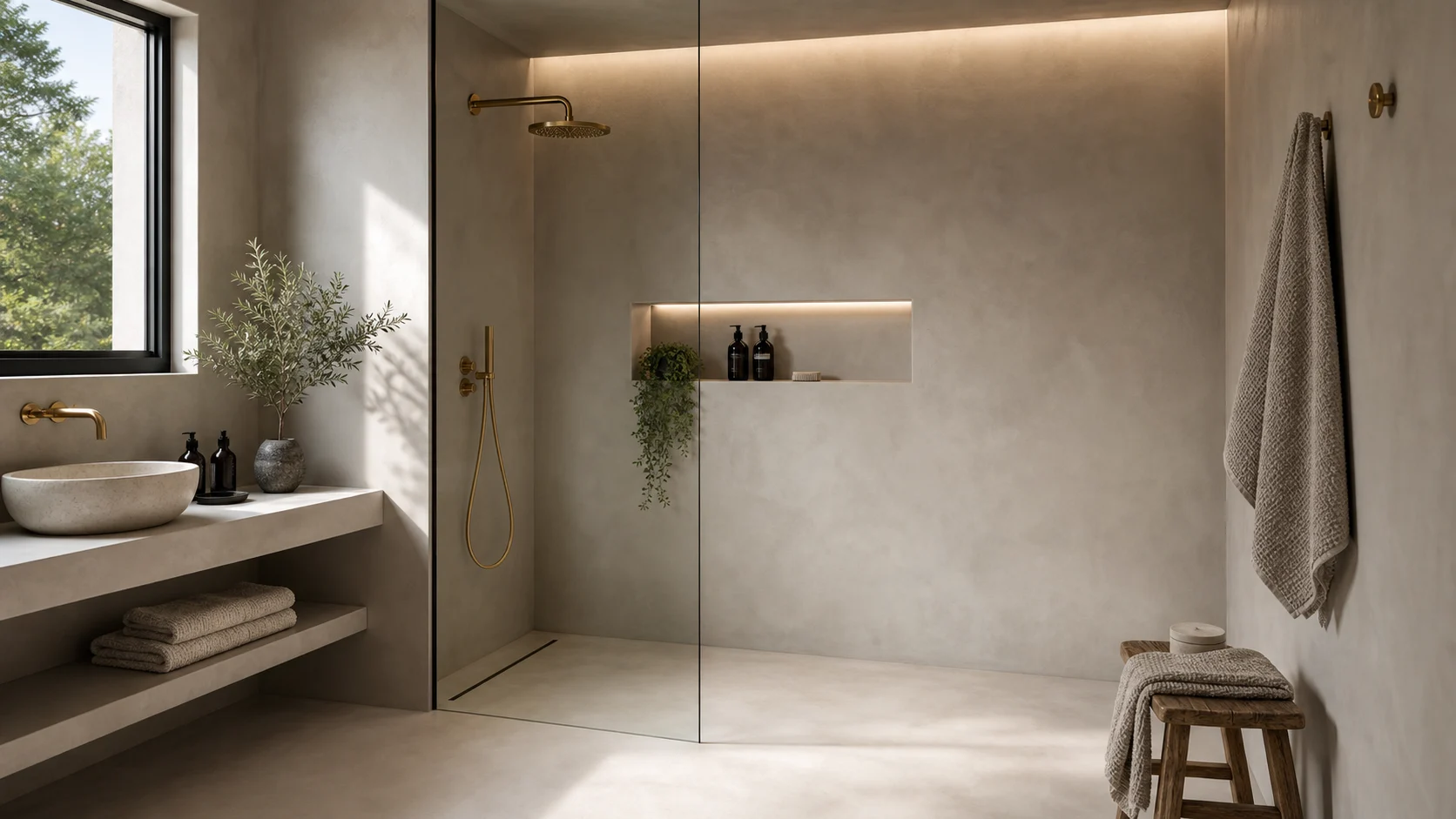
Short answer
Yes — installed correctly, an ATRIA microcement bathroom or shower is a waterproof system. A code-compliant waterproofing membrane goes down first; the microcement and its closed-pore polyurethane topcoat go over it, giving a seamless, waterproof surface for showers, spas, and steam rooms — with no grout lines to fail. The waterproofing comes from the membrane in the assembly; the coating itself is not a standalone membrane.
A quick note from me before you read this
This is the question that decides most bathroom projects, so let me answer it plainly: yes — installed correctly, an ATRIA microcement shower or wet room is a waterproof system.
The important word is system. A bathroom is a direct-water environment with drains, corners, movement, steam, and daily use. Microcement performs beautifully there, but it does so as part of an engineered assembly — not as a single coating doing every job at once. The waterproofing is handled by a dedicated layer; the microcement gives you the seamless, grout-free, easy-to-clean surface on top.
Understanding that split — what makes the assembly waterproof, and what the finish itself contributes — is the whole answer. Here it is, layer by layer.
How a waterproof microcement wet area is built
"Waterproof by assembly" is not a hedge — it is how every durable wet area is built, tile included. The waterproofing lives in a dedicated layer beneath the finish, and the finish is chosen for performance and looks. In the ATRIA wet-area build the order is fixed:
A code-compliant waterproofing membrane or liquid-applied waterproofing layer goes down first and does the actual waterproofing. Over it go the primer, fiberglass mesh reinforcement, the SuperTitanium BC decorative coats, and the New Atriapol Antibacterial polyurethane topcoat. The result is a continuous, waterproof surface with no grout lines to fail or re-caulk — which is exactly why clients move to microcement in wet areas in the first place.
The wet-area assembly, layer by layer
| Layer (bottom to top) | What it does |
|---|---|
| Waterproofing membrane / liquid layer | Stops water reaching the substrate — the actual waterproofing |
| Primer (Atriafloor / Primerquarz) | Bonds the system to the prepared surface |
| Fiberglass mesh reinforcement | Bridges stress and adds crack resistance |
| SuperTitanium BC (2 coats) | Seamless, dense polyurethane-mineral decorative finish |
| New Atriapol Antibacterial topcoat | Closed-pore, anti-absorbent, water-shedding, ISO 22196:2011 hygienic seal |
What the topcoat does — and what it doesn't
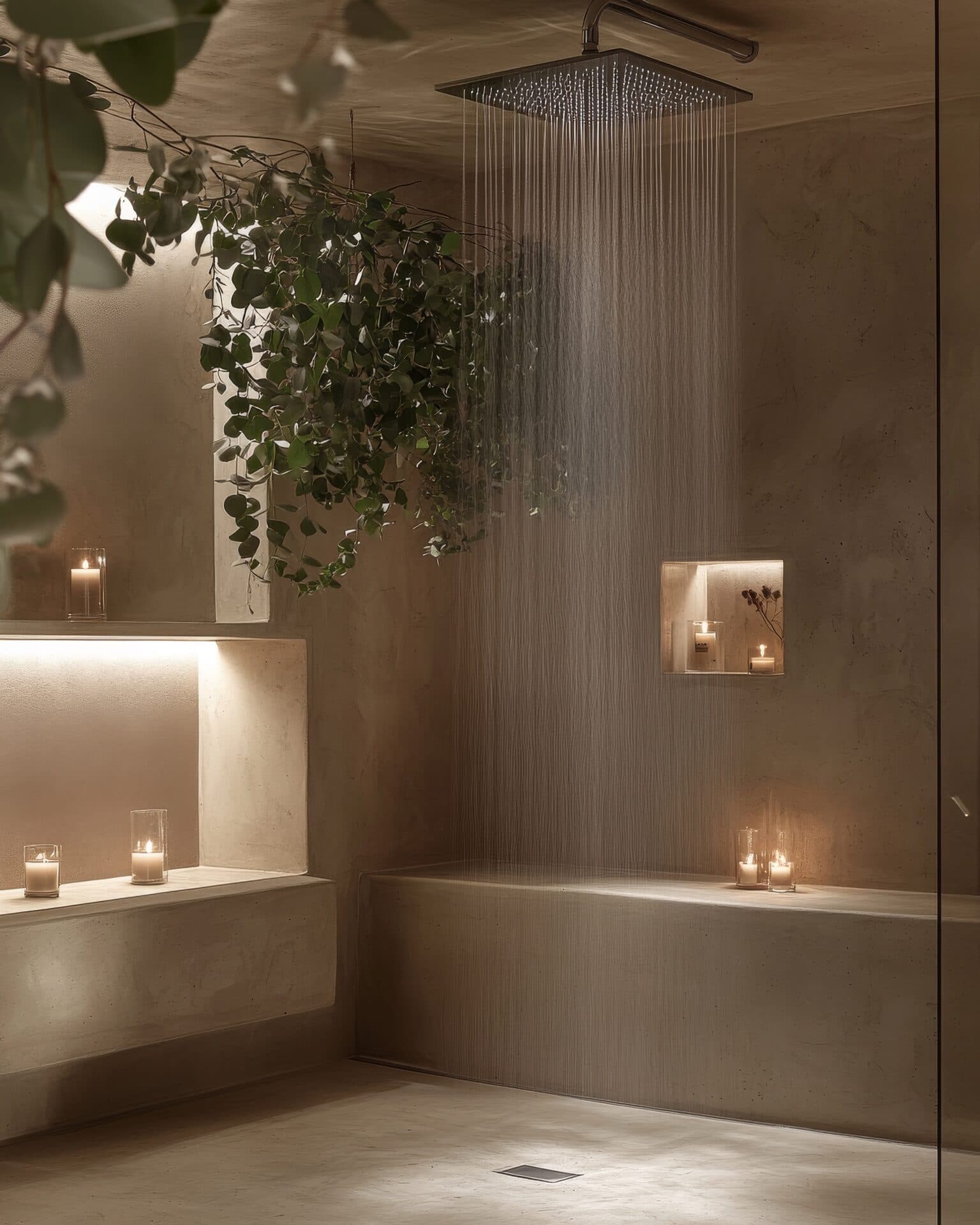
I am precise about this because it is where honest manufacturers and marketing part ways. Our New Atriapol Antibacterial topcoat is a closed-pore, anti-absorbent two-component polyurethane finish. Its TDS shows very low capillary water absorption (0.052 kg/m²·h^0.5, EN 1062), DIN 53778 wet abrasion above 10,000, and ISO 22196:2011 antibacterial performance. In plain terms: it sheds water, resists staining, cleans easily, and stays hygienic.
What it is not is a waterproofing membrane, and we never present it as one. The membrane beneath the microcement is what stops water reaching the substrate; the topcoat is the durable, water-shedding, hygienic surface on top. Both matter, and in a correctly built assembly they work together to give you a waterproof wet area.
Showers, tub surrounds, spas, and steam rooms
Built as the complete wet-area system over the correct waterproofing, ATRIA microcement is fully suitable for the wettest rooms in the house: walk-in showers, tub surrounds, wet rooms, spas, and steam rooms. The seamless, closed-pore surface is well matched to humidity and frequent cleaning, and the absence of grout lines removes the usual failure point where mold and water intrusion start.
Two project realities still apply, as they would for any finish: shower floors need proper slope, drain detailing, and slip-resistance review, and the waterproofing layer must be specified for the substrate, the corners, and the local code. Get the assembly right and the finish is ready for daily wet-area use. No microcement system we have verified carries polyurethane in the decorative layer itself the way ATRIA does, which is part of why our finish holds up so well above the waterproofing line; ask any supplier to show you the same, layer by layer, in their TDS.
Frequently asked questions
Is microcement waterproof?
Yes — installed correctly, an ATRIA microcement bathroom or shower is a waterproof system. The build starts with a code-compliant waterproofing membrane or liquid-applied waterproofing layer; the microcement system and its closed-pore New Atriapol Antibacterial polyurethane topcoat are installed over it. Built that way the finished assembly is waterproof and fully suitable for showers, tub surrounds, spas, and steam rooms, with no grout lines to fail. The waterproofing is delivered by the membrane within the assembly — the decorative coating itself is not a standalone membrane, so the membrane always goes underneath.
Can microcement be used in a shower?
Yes, when it is installed as a complete wet-area system: a code-compliant waterproofing layer first, then primer, fiberglass mesh reinforcement, the SuperTitanium BC decorative coats, and the Atriapol polyurethane topcoat. Built that way it gives a seamless, waterproof shower surface with no grout lines. Shower floors also need project-specific slope, drain, and slip-resistance detailing.
Is microcement waterproof without a membrane?
No. The decorative microcement coating is not a substitute for a waterproofing membrane, so in any direct-water area a code-compliant waterproofing membrane or liquid-applied layer always goes down first. The microcement system installed over it makes the finished assembly waterproof; the membrane is what actually stops water from reaching the substrate.
Is microcement good for steam rooms and spas?
Yes. Built as the complete wet-area system over a code-compliant waterproofing layer, ATRIA microcement is suitable for steam rooms, spas, and wet rooms. The closed-pore, anti-absorbent New Atriapol Antibacterial polyurethane topcoat gives a dense, low-absorption, hygienic surface (ISO 22196:2011) that handles humidity and frequent cleaning, while the membrane beneath handles the waterproofing.
Does microcement let water through?
A correctly built assembly does not. The waterproofing membrane beneath the finish stops water from reaching the substrate, and the polyurethane microcement above is dense and low-absorption — the Atriapol topcoat shows very low capillary water absorption (0.052 kg/m²·h^0.5, EN 1062) and DIN 53778 wet abrasion above 10,000. The coating is the durable, water-shedding finish; the membrane is the waterproofing layer.
Is ATRIA microcement waterproof?
Yes, as the installed system. Over a code-compliant waterproofing layer, the ATRIA PURO microcement system — sealed with the closed-pore New Atriapol Antibacterial polyurethane topcoat — gives a seamless, waterproof wet-area surface for showers, spas, and steam. No single product, including the topcoat, is itself a waterproofing membrane, so the waterproofing layer beneath the finish is never optional.
Go deeper
About the author
Enzo Atria
Owner & 2nd-generation lead, Colorificio Atria S.r.l. · Partanna, Sicily
Enzo leads Colorificio Atria, the Italian manufacturer behind the PURO polyurethane-mineral microcement system and the VENEZIANO Venetian plaster collection. Over two decades he has built ATRIA into one of Europe's reference-standard microcement houses, with specification work in luxury residential, hospitality, and healthcare across Italy, the Middle East, and — more recently — the US through ATRIA USA. He oversees formulation, QC, and the certified installer training program out of the Partanna facility.
LinkedIn →