A quick note from me before you read this
I started writing this because I keep getting the same call from American homeowners and architects: “Enzo, I had microcement installed two years ago and it's already cracking. Why?”
The answer, nine times out of ten, is that they didn't actually buy microcement. They bought something sold under that name.
I run Colorificio Atria out of Partanna, Sicily — the same family workshop my father founded in 1968. Our team has formulated polyurethane-mineral microcement for the European luxury market for over two decades, and the gap between what “microcement” means in Italy versus what it means in the US is wide enough to drive a truck through. So this post is the one I wish someone had handed my US clients before they signed their first contract.
If you only read one thing, read this: “microcement” is three different chemistries wearing the same label, and only one of them performs the way the marketing promises. The cheapest version — acrylic-cement — is what most US homeowners end up with. The premium version, polyurethane-mineral, is what the European luxury segment has increasingly specified since the early 2000s, particularly for hospitality, healthcare, and high-end residential. They cost roughly the same to market and look identical on Instagram. They perform nothing alike.
Before you commit to a project, ask your installer one question: “Is the binder polyurethane-mineral, acrylic-cement, or epoxy-modified?” If they can't answer, walk.
The three chemistries, explained the way I'd explain them to a neighbor
All microcement shares the same bones. Fine cement or mineral filler. A binder. Pigment. Water. What changes everything — cost, lifespan, crack behavior, whether it actually survives a shower — is the binder.
Acrylic-cement microcement — the budget tier
This is what most US contractors are selling when they say “microcement.” Cement mixed with acrylic polymer resin, often imported in bulk from Spanish or Turkish suppliers. Good margins for the installer. Cheap at the front door.
Here's what happens after year two. Acrylic resin flexes maybe ten percent before it fails, and every floor in every house on earth moves more than that over a season. So you get hairline cracking along the stress lines. The acrylic layer is also vapor-permeable, which means wet rooms develop efflorescence — that chalky white bloom on bathroom walls — within eighteen months. Any “antimicrobial” claim from acrylic-cement is a surface treatment that wears off the first time someone cleans it with anything stronger than water.
Typical installed cost in the US: $8–$15 per square foot. Typical useful life in a residential bathroom: seven to ten years before visible degradation. This is the product that generates the phone calls I mentioned in the intro.
Epoxy-modified microcement — the industrial tier
Cement mixed with epoxy resin, or an epoxy top coat applied over an acrylic-cement base. You see this in warehouses, car dealerships, some commercial kitchens. It solves the crack problem — sort of — but introduces two new ones.
Epoxy yellows under UV. A pool deck or sun-exposed patio will visibly shift tone within two years, and once it shifts, there's no fixing it without a full grind-and-reapply. Epoxy also off-gasses VOCs during cure and for weeks after. Fine for a Walmart stockroom. Not what you want your toddler learning to crawl on.
Typical installed cost: $12–$20 per square foot.
Polyurethane-mineral microcement — the premium tier
This is what we make. The binder is polyurethane — the same elastomeric polymer used in running shoe midsoles, medical devices, and automotive suspension bushings, because it bonds tightly while flexing with whatever it's bonded to. The mineral fillers are quartz, marble sand, and Etna volcanic mineral, ground to controlled grain size for the formulation. Quartz brings high hardness and abrasion resistance, marble sand adds brightness and a refined Venetian character, and the Etna volcanic mineral contributes density and mechanical interlock — harder than Portland cement, denser, with lower porosity.
Cured, the PURO finish itself is hard-elastic and closed-pore — non-absorbent, non-wicking, and naturally resistant to water penetration at the surface. It's not the waterproofing layer in the assembly (the liquid waterproofing primer beneath the rasante is), but it means the finish you see and touch every day doesn't hold moisture, stain from a spilled glass of wine, or develop the efflorescence bloom that kills acrylic-cement installations in wet rooms. It flexes with substrate movement rather than cracking along stress lines. It doesn't yellow. It doesn't chalk. When paired with a two-component antibacterial top coat, the antimicrobial performance is cured into the polymer matrix, not sprayed onto it.
For wet rooms specifically — showers, tub surrounds, and bathroom floors — a microcement shower is built as a two-part assembly. A code-compliant liquid waterproofing membrane goes under the microcement: typically ARDEX 8+9 applied over reinforcing fiberglass mesh, or an epoxy-soaked mesh layer. That's the actual water barrier, the way every reputable wet-area spec is constructed. On top of that waterproofed substrate, the complete ATRIA Atriafloor cycle installs: Atriafloor Primer, two coats of Atriafloor Rasante One, two coats of SuperTitanium BC decorative resin, and two coats of the New Atriapol W antibacterial topcoat. Waterproofing is the architect's job; the finish is ours. Together, they deliver the exact wet-room specification European architects have been putting in boutique hotels and luxury residential wet rooms for two decades. Installed properly, a microcement shower is genuinely waterproof — not “water-resistant,” not “splash-safe” — waterproof.
The Sicilian residential installations we did in the late 1990s are still performing — no cracks, no refinishing, two decades later. That's the claim the marketing copy makes for every microcement on the market. It's only true for this one.
Typical installed cost in the US through ATRIA USA: $14–$18 per square foot for floors on our Fast tier, with Standard and Full Build tiers running higher for more demanding substrates (detailed tier architecture below).
The three chemistries at a glance
| Property | Acrylic-cement | Epoxy-modified | Polyurethane-mineral |
|---|---|---|---|
| Binder character | Semi-rigid | Rigid | Hard-elastic, closed-pore |
| Crack resistance | Poor | Poor | Excellent |
| Rated waterproof for showers & wet rooms | No | Partial | Yes |
| UV stability | Fair | Yellows | Non-yellowing |
| Antimicrobial (built-in, not surface-coated) | No | No | Yes (ISO 22196:2011 on 2-part PU top coat) |
| VOC profile | Moderate | High | Water-based, low-odor |
| Residential lifespan (properly installed) | 7–10 years | 8–12 years | 15–25+ years |
| Installed cost (US) | $8–$15/sf | $12–$20/sf | $14–$18/sf (Fast tier), up to $25–$34/sf (Full Build) |
Cost per year of useful life is where polyurethane wins decisively. A $12/sf acrylic floor that fails at year eight costs you $1.50 per square foot per year, plus the rip-out, plus the disruption. A $22/sf polyurethane floor that's still performing at year twenty is costing you around $1.10 per square foot per year, and you never touch it again.
Why the binder does all the work
I get asked a lot why we use polyurethane instead of acrylic. The honest answer is that we tried acrylic in the late nineties and it didn't work well enough.
Cement by itself is rigid and brittle. When the substrate moves — and every substrate moves, whether it's a slab settling in a California ranch house or a wood-framed floor in a Brooklyn brownstone breathing with the seasons — a rigid surface cracks along the movement lines. Acrylic resin helps a little, but ten percent elongation is nothing. One hot summer, one humid winter, and you're looking at spider-web cracking.
Polyurethane is elastomeric. It's a long-chain polymer that coils and stretches without breaking the covalent bonds holding it together. It's the same principle that lets a running shoe midsole compress twenty thousand times per mile without degrading, and it's the same reason our floors survive what kills cheaper systems. The binder flexes with the house. The surface stays intact.
The mineral side of the formulation is less glamorous but does a lot of quiet work. Portland cement has a Mohs hardness around three to four — soft enough that a copper coin can scratch it. The quartz, marble sand, and Etna volcanic mineral blend, ground to controlled grain size and bound in polyurethane, gives us a compressive strength of 32 ± 2 MPa at 28 days and a flexural strength of 3.5 ± 2 MPa at 28 days (both tested to EN 1015-11). Hard-elastic film with closed pores. Adhesion of the complete protected cycle tested above 3.6 MPa (EN 1542). The SuperTitanium binder is stable from −10°C to +120°C; the complete protected system operates from −10°C to +100°C — which is why we can specify it under radiant-heat floor systems and in high-thermal-swing interior environments without worrying about the finish failing.
These aren't marketing numbers. They're on the technical data sheet for SuperTitanium BC, and they are the numbers to use when comparing ATRIA against any other microcement system.
The antibacterial claim that actually holds up
Most “antimicrobial microcement” in the US market is making a surface-treatment claim — a silver-ion additive or a coated top layer that sounds impressive on the brochure and wears off in six to twelve months. We ran into this problem ourselves in the early 2010s when hospitals in Milan started specifying microcement for patient-facing surfaces and needed a performance standard that wouldn't degrade with daily cleaning.
The answer was New Atriapol Antibacterial. It's a two-component polyurethane top coat — resin plus hardener, mixed on-site — where the antibacterial chemistry is cured into the polymer matrix, not applied on top of it. Because it's crosslinked during cure, cleaning doesn't remove it. Scrubbing doesn't remove it. It's part of the surface itself.
We test it to ISO 22196:2011, the international standard for measuring antibacterial activity on plastic and non-porous surfaces — specifically against Escherichia coli and Staphylococcus aureus. That's the specification food-service architects and hospital infection-control officers recognize. Not a marketing claim — a test method that can be independently verified from the technical data sheet.
New Atriapol Antibacterial is one of the few two-component polyurethane microcement top coats we're aware of carrying ISO 22196:2011 certification. If a competitor claims the same, ask for the test data. A real manufacturer will hand it over in thirty seconds.
Where it matters in practice: hospitals, dental offices, commercial kitchens, childcare facilities, and residential wet rooms where the alternative is dealing with recurring mold and grout issues for the life of the installation.
Where polyurethane microcement actually goes
Floors. Kitchens, living rooms, entries, open-plan great rooms. Hotel lobbies, boutiques, showrooms, restaurants. Anywhere you'd otherwise specify polished concrete, stone tile, or a luxury-grade LVT — but want the seamless, no-grout continuity. A 2,400-square-foot restaurant floor in the UAE last year in SuperTitanium BC warm greige reads exactly like this: the kitchen passes off into the dining room without a transition line. That's the look most clients are chasing.
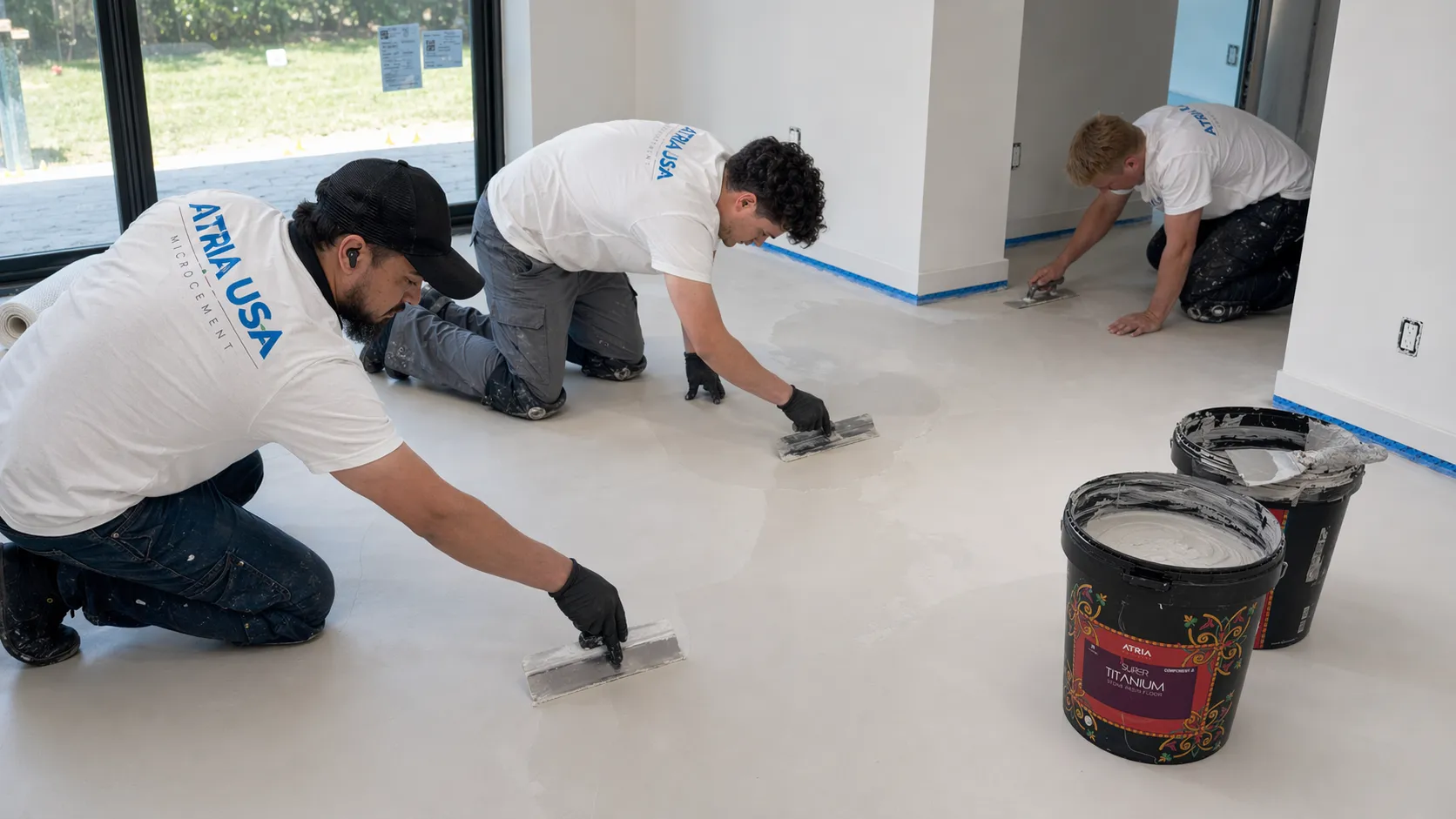
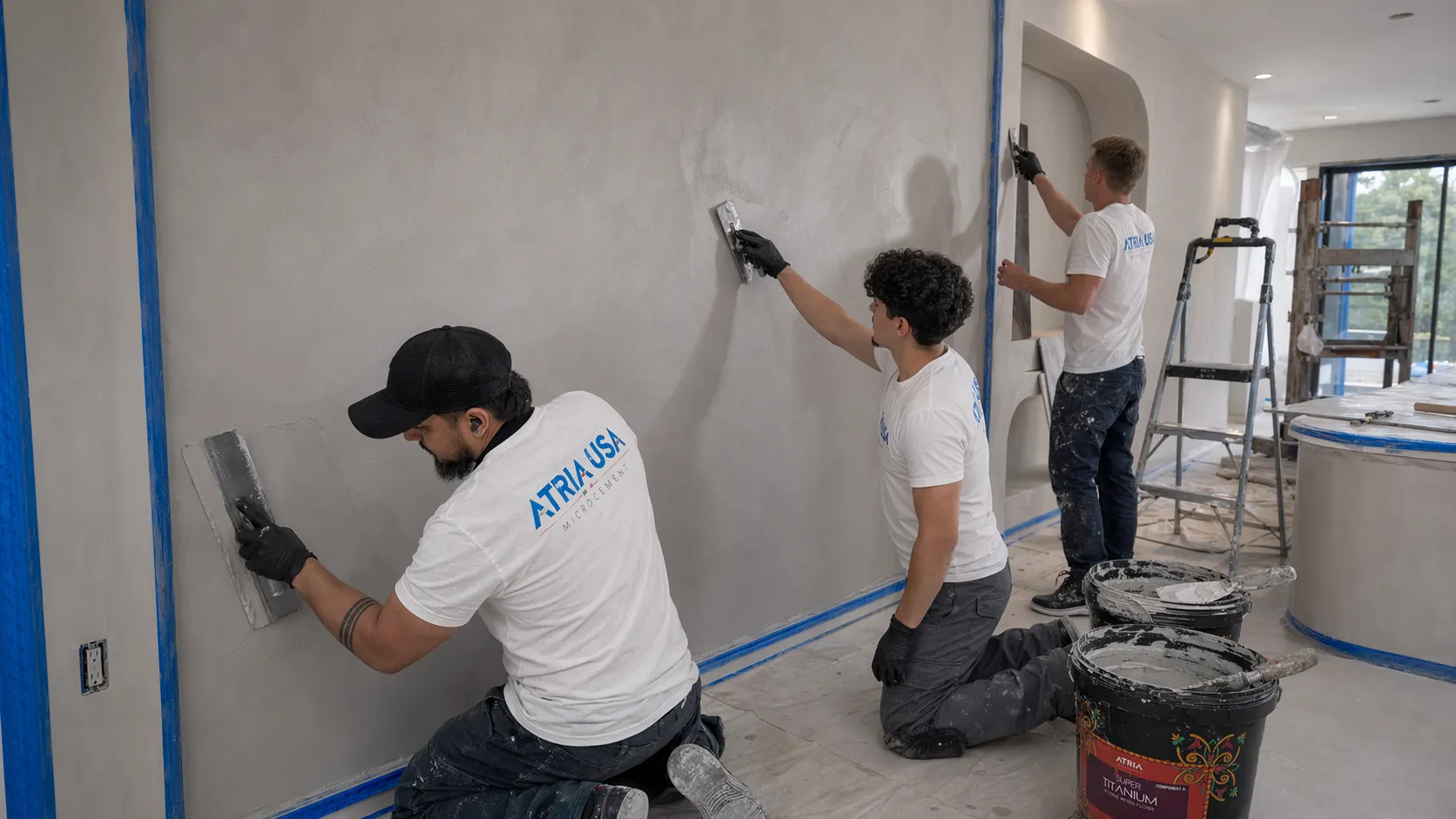
Walls. Bathrooms, shower interiors, feature walls, retail spaces. The full PURO wall system is about 1.5–3mm thick top to bottom, which means wall plates and trim don't need to be reworked. For renovation work this is a significant cost advantage over any stone or tile finish.
Wet areas. Shower floors and surrounds, tub enclosures, bathroom floors, and wet-room walls. This is where polyurethane microcement pulls decisively ahead of everything else. Built as a complete assembly — a code-compliant liquid waterproofing membrane (typically ARDEX 8+9 or equivalent, installed with reinforcing fiberglass mesh) under the full ATRIA Atriafloor cycle — the finished wet room is fully waterproof for daily showers and standing water contact. No grout. No tile seams. No lurking mold. Just one continuous, sealed, hard-elastic surface that looks like a finished luxury bathroom and performs like a spec'd wet room.
If you've stayed at a boutique hotel in Milan, Lisbon, or Copenhagen in the past five years and noticed a bathroom with a seamless stone-matte finish wrapping from floor to wall to shower, there's a good chance it was polyurethane-mineral. Now you know what you were looking at.
The questions to ask before you sign
Print this. Bring it to your consultation. If your installer can't answer five of the seven, get another quote.
- 1
What's the binder chemistry — polyurethane-mineral, acrylic-cement, or epoxy-modified?
Only the first is the premium product. If they don't know, they're a reseller, not an installer.
- 2
Is the top coat a two-part polyurethane system or single-component?
Two-part systems crosslink during cure and are significantly more durable. Single-component is the cheaper shortcut.
- 3
What's the manufacturer's specified lifespan for residential?
Properly installed polyurethane-mineral lasts 15–25+ years. Anything rated under ten years is probably acrylic-cement.
- 4
Can you show me the technical data sheet for every product in the system?
A real installer has TDS documents for each layer. If you get a generic brochure instead, that is your answer.
- 5
What substrate prep is specified, and what primer are you using?
Concrete, screed, ceramic, stoneware, and tile all get Atriafloor Primer BC. The substrate has to be sound first — solid, dry, and vacuumed free of dust and loose material. Primer BC anchors to a sound surface; it will not consolidate a chalky or friable slab, so make that good before you prime. Walls get Primerquarz. Wet areas need a liquid waterproofing primer applied before the rasante. Substituting primers is the number-one cause of installation failure I see in the US market.
- 6
How many coats, and what's between them?
A proper PURO floor is a full system: primer (Atriafloor Primer BC, or Primerquarz on walls), two coats of Atriafloor Rasante One for the base, two coats of Titanium or SuperTitanium BC for the decorative finish, and two coats of New Atriapol Antibacterial as the protective top layer. Standard and Full Build tiers add fiberglass mesh reinforcement and — for wet areas or engineered substrates — a liquid waterproofing primer under the rasante. Walls follow the same logic with Primerquarz as the wall primer. Shortcuts here are visible within two years.
- 7
What is the manufacturer warranty, and does it transfer with the property?
Premium polyurethane-mineral systems carry manufacturer-backed warranties that transfer. Acrylic-cement typically doesn't. If you're investing in a premium finish, the warranty should survive a sale.
The honest cost conversation
Polyurethane-mineral costs more upfront than acrylic-cement. There's no way around that, and I'm not going to pretend otherwise.
What I can tell you is how the numbers actually shake out on a real project, because ATRIA USA publishes pricing as starting-from anchors tied to our three installation tiers:
Floors — $14–$34/sf depending on tier. The tier you end up in is determined mostly by your substrate. A sound concrete slab or polished-concrete substrate qualifies for our Fast tier ($14–$18/sf, five-layer system). Tile, backer board, or gypsum self-leveler moves you to Standard ($19–$24/sf, six-layer system). MDF, plywood, OSB, radiant-heat slabs, or steel require Full Build ($25–$34/sf, eight-layer system with Glass Mat 300 fiberglass mesh reinforcement and extended cure protocol). Substrate dictates tier — it's not a marketing choice, it's engineering. Our full 16-color PURO palette is available at every tier, with custom color-matching to NCS, RAL, and major paint-brand references available on request.
Walls — $18–$36/sf. Same tier logic, different bands. Fast tier walls on sound drywall or skim-coated plaster run $18–$22/sf. Standard wall systems on more complex substrates run $23–$28/sf. Full Build wall specifications — think commercial wet rooms, substrate-integrated lighting, structural transitions — run $29–$36/sf.
Ceilings — $26–$50/sf. Ceilings carry additional labor because of the overhead application and because our ceiling systems are almost always wet-area or specialty work. Bands: Fast $26–$32/sf, Standard $32–$38/sf, Full Build $40–$50/sf.
Finish options. The PURO range includes two decorative microcement finishes, both available at every tier. Titanium is the single-component formula — a clean, reliable choice for the majority of interior residential work. SuperTitanium BC is the two-component premium formula, engineered for bathrooms, wet rooms, and commercial-grade floors where the higher mechanical resistance and the bicomponent chemistry matter most. The product selection follows the project, not the price tier.
Project minimums apply per tier — the minimum reflects the cost of mobilizing an ATRIA-certified crew for a project day. For smaller rooms, the minimum is the floor you're working from.
Now the math. A typical 150 sq ft full bath with shower in a Standard-tier wall-and-floor spec runs roughly $4,200–$6,500 all in. A 1,200 sq ft kitchen-plus-living-room floor on a sound concrete slab in Fast tier runs $17,000–$22,000. A whole-home Full Build floor with SuperTitanium BC on a radiant-heat substrate is a different conversation — typically $30,000–$40,000 for the same 1,200 sq ft.
Is that cheap? No. Is it cheaper than doing acrylic-cement twice over twenty-plus years, plus the rip-out, plus the disruption? Every time.
In the high-end US real estate market, seamless Italian finishes are increasingly showing up on luxury listings as a differentiator — not because there's a magic resale number attached, but because designer-aware buyers recognize the finish as a premium install and remember the homes that feature it. The carry-forward value is in the listing photography, the showing, and the story, not in a specific line item.
FAQ
What's the difference between microcement and polyurethane microcement?
"Microcement" is a category term covering three binder chemistries: acrylic-cement, epoxy-modified, and polyurethane-mineral. Polyurethane microcement specifically uses a polyurethane binder with a quartz, marble sand, and Etna volcanic mineral filler, which is more flexible, more waterproof, and longer-lasting than acrylic-cement microcement.
Is polyurethane microcement waterproof?
Yes — a properly built microcement shower, tub surround, or wet room is fully waterproof. The assembly is two-part: a code-compliant liquid waterproofing membrane (typically ARDEX 8+9 over reinforcing fiberglass mesh, or an epoxy-soaked mesh layer) creates the actual water barrier under the microcement, and the complete ATRIA Atriafloor cycle — primer, rasante, decorative resin, and polyurethane antibacterial topcoat — installs on top as the decorative and protective finish. This is the spec European architects use in boutique hotels and luxury wet rooms. Acrylic-cement microcement is only water-resistant and cannot be specified for permanent wet exposure — that's one of the main reasons the chemistry distinction matters.
How long does polyurethane microcement last?
15–25+ years in typical residential applications, 10–15 years in high-traffic commercial applications, when installed per manufacturer specification on a properly prepared substrate. That’s 2–3× the useful lifespan of acrylic-cement microcement.
Does polyurethane microcement crack?
The polyurethane binder is elastomeric and closed-pore — it flexes with normal substrate movement rather than cracking along stress lines the way acrylic-cement microcement does. Cracking in polyurethane-mineral microcement almost always indicates a substrate or installation error (movement, moisture, primer mismatch) rather than a material failure.
Is polyurethane microcement antimicrobial?
When installed with a two-component polyurethane antibacterial top coat — such as ATRIA’s New Atriapol Antibacterial, tested to ISO 22196:2011 — the surface is genuinely antimicrobial because the antibacterial protection is built into the cured polymer matrix. It doesn’t wear off with cleaning. Single-component or surface-treated antimicrobial claims typically lose effectiveness within 6–12 months.
How much does polyurethane microcement cost per square foot?
ATRIA USA publishes tier-based pricing bands. Floors run $14–$18/sf (Fast), $19–$24/sf (Standard), and $25–$34/sf (Full Build). Walls and ceilings have their own bands. The tier you fall into is determined by substrate type and system specification, not client choice. See our pricing tiers.
Can polyurethane microcement be installed over existing tile or concrete?
Yes, with the right substrate prep. Sound concrete qualifies for our Fast tier. Tile requires diamond grinding for a mechanical key, then Primerquarz (walls) or Atriafloor Primer (floors) before the rasante base layer — that moves the project into Standard tier minimum. MDF, plywood, and radiant-heat substrates require Full Build tier because of the fiberglass mesh reinforcement and the extended cure protocol.
How is polyurethane microcement different from epoxy floors?
Epoxy flooring is a single-layer polymer coating, typically 1–3mm thick, with an industrial appearance. Polyurethane microcement is a multi-layer cementitious-binder system with a natural stone-matte aesthetic, flexibility (epoxy is rigid), UV stability (epoxy yellows), and the ability to be applied to walls (epoxy is floor-only). See our dedicated microcement vs epoxy comparison.
Further reading
- What is ATRIA SuperTitanium microcement?
- What is ATRIA USA microcement?
- How to compare microcement systems by TDS
- What is microcement? A complete guide
- Microcement vs tile: which is right for your bathroom?
- Microcement vs epoxy: full comparison
- Microcement bathroom cost breakdown
- PURO microcement system — full product spec
- Find a certified ATRIA installer near you
About the author
Enzo Atria
Owner & 2nd-generation lead, Colorificio Atria S.r.l. · Partanna, Sicily
Enzo leads Colorificio Atria, the Italian manufacturer behind the PURO polyurethane-mineral microcement system and the VENEZIANO Venetian plaster collection. Over two decades he has built ATRIA into one of Europe's reference-standard microcement houses, with specification work in luxury residential, hospitality, and healthcare across Italy, the Middle East, and — more recently — the US through ATRIA USA. He oversees formulation, QC, and the certified installer training program out of the Partanna facility.
LinkedIn →Spec the right microcement for your project
Talk to an ATRIA-certified team about the PURO system — tier pricing, substrate assessment, and the right finish for your space.