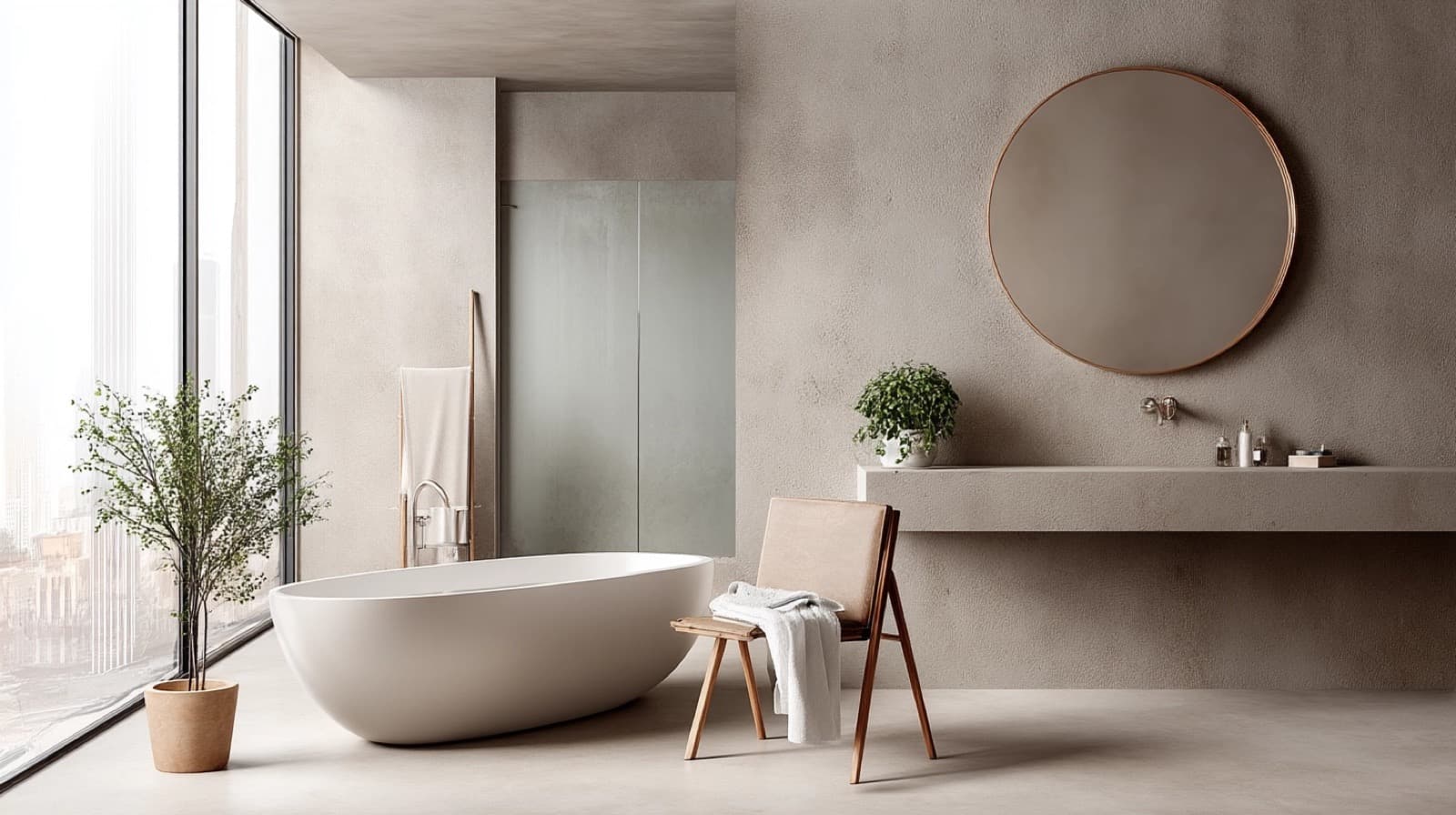
If you’re researching microcement vs polished concrete, you’re not alone. Both finishes deliver a seamless, architectural look that designers love. Both can feel modern, minimal, and luxurious. Both are often discussed in the same conversation. But they are not interchangeable systems.
The core difference is simple: polished concrete refines an existing concrete slab, while microcement is a high-performance decorative coating applied over many substrates. That distinction affects everything—your budget, your construction timeline, your design flexibility, and whether your project is even feasible without major demolition.
In this guide, ATRIA USA breaks down the real-world differences between microcement and polished concrete so homeowners, designers, builders, and developers can choose confidently.
What Is Microcement?
Microcement is a thin, trowel-applied cementitious system that typically builds to just 2–3 mm. It is installed in multiple layers—primer, base coats, finish coats, and protective sealer/topcoat—to create a continuous surface with no grout lines.
Because it is an overlay, microcement can be installed over existing materials such as tile, concrete, plasterboard assemblies, and prepared wall systems. That makes it one of the most useful options for renovations where the goal is to avoid tear-outs and still achieve a premium monolithic finish.
Explore ATRIA’s complete microcement product line to see available systems, finishes, and project support options.
What Is Polished Concrete?
Polished concrete is the process of mechanically grinding, densifying, and polishing a concrete slab. Rather than covering the slab, you’re finishing the slab itself. Contractors move through progressively finer diamond grits until the floor reaches the target sheen (matte, satin, or high-gloss).
This system is excellent when you already have the right slab condition and enough depth for grinding. It is especially common in commercial spaces, warehouses, galleries, and modern new construction where exposed concrete is part of the architectural intent.
Microcement vs Polished Concrete: Quick Comparison
| Category | Microcement | Polished Concrete |
|---|---|---|
| Installed cost (typical) | Tier-based: $14–$18 Fast · $19–$24 Standard · $25–$34 Full Build (per sq ft) | $6–$15/sq ft on an ideal slab |
| Renovation cost reality | Often lower total cost due to no demolition | Can rise quickly with slab repairs + removal work |
| Thickness | 2–3 mm overlay | Existing or new structural slab |
| Substrates | Tile, concrete, drywall, cement board, some wood assemblies | Concrete only |
| Floors + walls | Yes, one continuous look | Floor-only system |
| Design options | Wide color range + hand-troweled movement | Natural concrete tones, aggregate exposure options |
| Durability | Excellent for homes, hospitality, retail with proper system | Exceptional for heavy-duty floor traffic |
| Maintenance | Neutral cleaner + periodic topcoat maintenance | Dust mop + occasional burnish/re-polish |
| Timeline | Multi-day layered application | Fast on great slabs, slower if slab remediation is needed |
Cost Comparison: What You Really Pay
In many online comparisons, polished concrete appears dramatically cheaper. That is true only under one condition: you already have a clean, level, crack-controlled, coating-free slab in good shape. In real renovations, that condition is less common than people think.
Typical cost ranges
- Microcement installation: tier-based by substrate — Fast $14–$18/sf (sound concrete), Standard $19–$24/sf (tile, backer board, gypsum), Full Build $25–$34/sf (MDF, plywood, radiant-heat, commercial wet rooms).
- Polished concrete on ideal slab: roughly $6–$15/sq ft.
- Polished concrete with remediation: can exceed microcement when repairs are extensive.
Hidden costs that change the math
If your project has tile removal, adhesive residue, moisture issues, large slab cracks, low spots, patching, or level corrections, polished concrete costs can rise quickly. Microcement often avoids those demolition and slab-repair costs because it is designed as an overlay system.
For budget planning, use ATRIA’s project cost calculator and request a site-specific quote before committing to either pathway.
Installation Process: Renovation vs New Build
Microcement Installation
- Surface prep and adhesion primer
- Base coat build-up with reinforcement where required
- Decorative finish coats (hand-troweled texture and movement)
- Protective topcoats for stain/water resistance
- Commonly 4–6 days depending on scope and cure windows
Polished Concrete Installation
- Mechanical grinding to remove coatings and flatten slab
- Crack/joint treatment and patching
- Densifier application and progressive polishing passes
- Final protective treatment depending on system
- Fast on excellent slabs; longer when slab correction is needed
The biggest decision driver is project context: for slab-on-grade new construction, polished concrete can be very efficient. For remodels, upper floors, bathrooms, and wall integrations, microcement is often the more practical and design-flexible route.
Durability and Lifespan
Polished concrete is famous for longevity in high-traffic commercial environments. Properly executed, it can handle decades of service. Microcement also offers long service life when installed as a complete system and maintained correctly, especially in residential and light-commercial environments.
In practice, both can be durable. The right question is not “which is stronger on paper?” but “which system is better matched to your substrate, moisture conditions, and daily use?” Specification quality and installer skill matter more than marketing claims.
Aesthetics: Why Designers Choose One Over the Other
If your goal is raw industrial authenticity, polished concrete is hard to beat. You can reveal aggregate, keep tonal variation, and celebrate the natural character of the slab.
If your goal is a curated seamless look across floors, walls, bathrooms, fireplaces, stairs, and millwork, microcement is dramatically more versatile. Designers can control tone, movement, finish level, and continuity in ways polished concrete cannot match.
For inspiration, browse ATRIA’s project gallery and compare how seamless surfaces are used in both contemporary residential and boutique commercial spaces.
Maintenance: Day-to-Day and Long-Term
Microcement maintenance
- Use pH-neutral cleaners and soft pads/mops.
- Avoid harsh acidic or highly alkaline chemicals.
- Recoat/refresh protective layers based on wear conditions.
- Address small issues early to preserve visual continuity.
Polished concrete maintenance
- Frequent dust mopping protects sheen and reduces abrasion.
- Use cleaners formulated for polished concrete.
- Periodic burnishing or re-polishing restores appearance in high-use zones.
- Stain management and joint care remain important in active spaces.
When to Choose Microcement
- You are renovating and want to avoid demolition.
- You need one seamless finish across floors and walls.
- You want design-forward texture, color control, and handcrafted movement.
- You are working in bathrooms, spas, or hospitality spaces that benefit from grout-free surfaces.
- You want a polished-concrete aesthetic where polished concrete is impractical.
See ATRIA’s microcement services for project planning and installation support.
When to Choose Polished Concrete
- You already have a high-quality slab with minimal remediation needs.
- You want authentic exposed-concrete character.
- Your project is floor-focused and does not require wall continuity.
- You’re specifying for very heavy traffic with industrial performance priorities.
Frequently Asked Questions
Is microcement cheaper than polished concrete?
It depends on starting conditions. On a perfect slab, polished concrete can be cheaper. In renovations, microcement often has equal or better total value once demolition and slab remediation are included.
Can microcement look like polished concrete?
Yes. Many clients choose microcement specifically to achieve a concrete-inspired look with more design control and without structural slab constraints.
Which option is better for bathrooms?
For seamless wall-to-floor bathroom design, microcement is generally better because it is an overlay system that can run continuously across multiple surfaces.
Final Verdict: Microcement vs Polished Concrete
If your project is a renovation, requires surface continuity, or prioritizes design flexibility, microcement is usually the stronger choice. If you have the right slab and want authentic exposed concrete performance, polished concrete can be excellent. The best system is the one that fits your substrate, schedule, and design goals—not just a price per square foot found online.