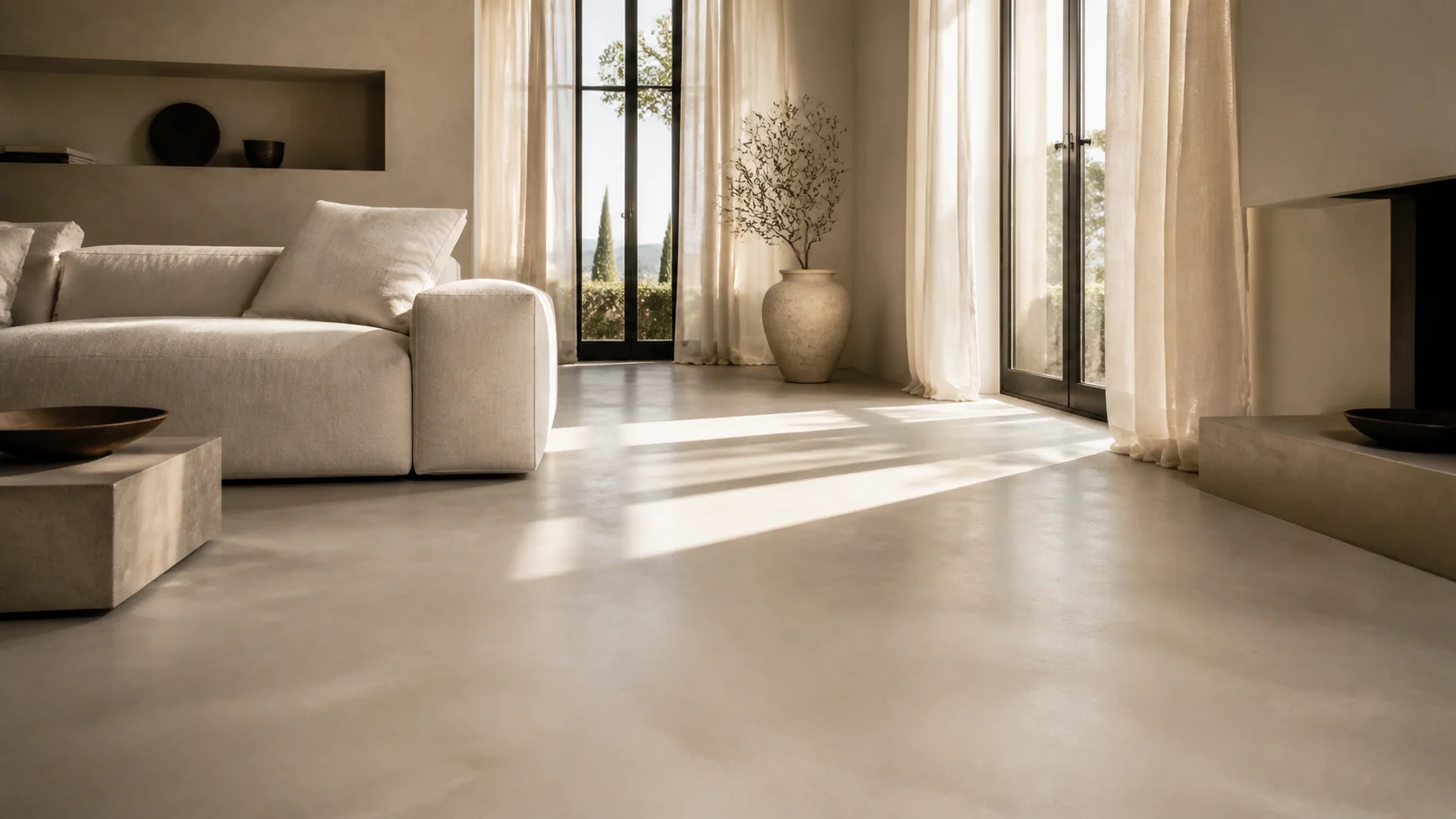
A quick note from me before you read this
A question I get constantly from US clients: "Does microcement yellow over time like epoxy does?"
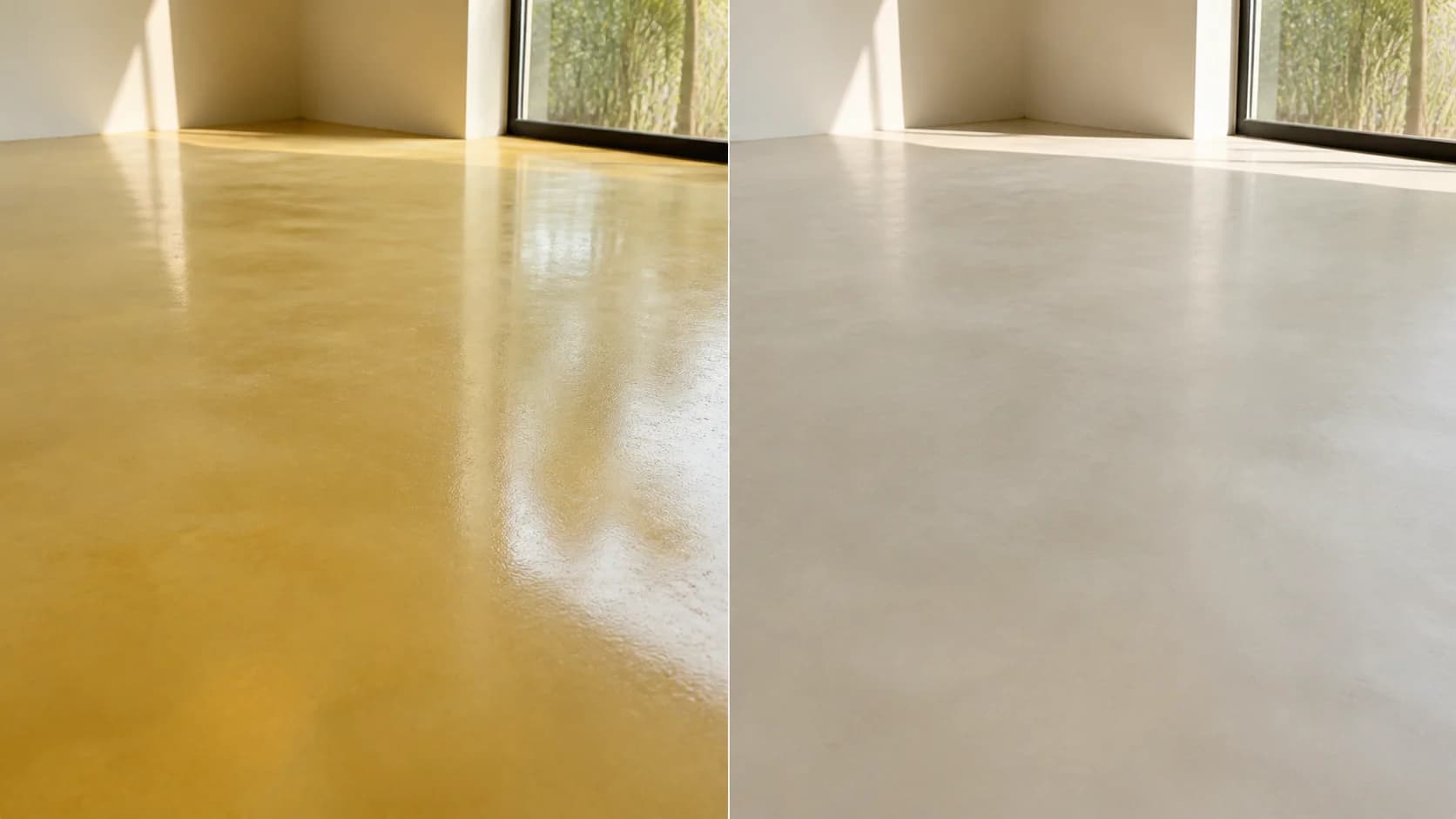
The short answer: it depends primarily on the topcoat chemistry, not the microcement name itself. Some microcement systems yellow within 18–24 months of sunlight exposure. Properly sealed polyurethane-mineral systems are specified to hold their tone long-term under normal interior UV exposure.
The difference between those two outcomes has very little to do with "microcement vs epoxy" at the category level. It has everything to do with the specific polyurethane topcoat sealed over the decorative layer. There are two families of polyurethane commonly discussed in decorative flooring — aromatic and aliphatic — and aliphatic polyurethane is the UV-stable choice for light-colored, sun-exposed finishes. Aromatic polyurethane is more prone to yellowing under UV.
This post explains the chemistry in plain terms, tells you the one question that separates a finish that holds up from one that doesn't, and clears up the most common confusion in the US market: people lumping "microcement" and "epoxy" together as if they're the same thing. They're not.
The quick answer: three categories, three different yellowing stories
Epoxy flooring (not microcement, but often confused with it): Yes. Epoxy systems commonly include UV-sensitive resin and hardener chemistry that can yellow or chalk under sunlight. Many epoxy floors will shift tone over time, and in high-UV environments (Texas sun, south-facing rooms, outdoor patios) it happens faster. The industry's own solution is often to protect epoxy with a UV-stable aliphatic polyurethane topcoat — because standard epoxy by itself is not the best color-stable finish for sunlight.
Acrylic-cement microcement: Generally no pronounced yellowing in the microcement layer itself, but the cheaper acrylic topcoats often used on these systems can yellow or chalk within 2–3 years. The failure mode tends to be dullness + hazing more than an amber shift.
Polyurethane-mineral microcement with a two-component aliphatic polyurethane topcoat (what ATRIA builds): This is the non-yellowing specification. Properly formulated aliphatic polyurethane is used for UV-stable topcoats because it is far less prone to ambering than epoxy or aromatic polyurethane. Our Atriapol Antibacterial topcoat is specifically formulated to be non-yellowing and UV-resistant, and it's what goes over the decorative coats in the PURO system. The result is a finish specified to hold tone under normal interior daylight exposure.
What actually happens when a coating yellows
Yellowing isn't dirt. It's photo-degradation — UV radiation breaking down the molecular structure of the coating.
Here's the simple version: certain polymer chains have unsaturated bonds (sometimes drawn as C=C or represented by benzene rings). UV light carries enough energy to break those specific bonds apart. Once they break, the molecule reorganizes, often into a structure that absorbs blue light — and the surface visibly shifts toward yellow or amber. The degradation builds up in the top few microns of the coating, so once it starts, there's no reversing it without stripping and re-coating.
Saturated polymer chains — the kind without the same vulnerable aromatic structures — are far less prone to this yellowing mechanism. That's why some coating chemistries age cleanly in daylight while others turn amber in a single summer.
This is settled coating chemistry. It's not controversial and it's not a marketing claim — any coating chemist will tell you the same general rule: epoxy and aromatic polyurethane are more prone to UV yellowing, while properly formulated aliphatic polyurethane and polyaspartic topcoats are used when non-yellowing UV stability matters.
Aromatic vs aliphatic polyurethane — the one distinction that matters
The single most useful thing a microcement buyer can learn is that "polyurethane topcoat" is not one thing. It's two chemistries that share a name.
Aromatic polyurethane
Built from aromatic isocyanates — most commonly MDI (methylene diphenyl diisocyanate). Cheaper. Very common in generic industrial polyurethane coatings. Contains aromatic structures in the molecular backbone. More prone to yellowing under UV. Its own suppliers routinely position aromatic polyurethane for interior, covered, or basecoat applications where a UV-stable finish coat can protect the system.
If you see a microcement system marketed as "polyurethane-sealed" at a low price point, aromatic is usually what's in the bucket.
Aliphatic polyurethane
Built from aliphatic isocyanates — commonly IPDI (isophorone diisocyanate). Significantly more expensive to manufacture. No aromatic rings in the same exposed backbone. Resists yellowing under UV. This is the class of polyurethane used for UV-exposed work — exterior wood coatings, marine varnishes, automotive clear coats, and premium microcement topcoats.
Our Atriapol Antibacterial topcoat is a two-component water-dilutable polyurethane finish. The TDS lists it as UV-resistant and non-yellowing, and it is tested to ISO 22196:2011 for antibacterial performance. That's the product we put over SuperTitanium BC or Titanium decorative finish in the PURO system.
The cost of aliphatic polyurethane is real — it's noticeably more expensive per liter than aromatic. That's one reason cheaper microcement systems use aromatic topcoats or even acrylic sealers instead. The tradeoff shows up at year two or three, when the client's light-colored floor starts looking a half-shade warmer than it did on install day.
Why the "epoxy microcement" confusion happens in the US market
A couple months ago I saw a post in a microcement homeowner group where someone wrote: "I was told microcement is epoxy-based, so it yellows over time." The confusion is everywhere.
Here's what's actually going on:
Real microcement is a cementitious coating — cement or mineral filler bound with a polymer resin. Not the same thing as epoxy flooring.
Epoxy flooring is a thermosetting resin poured as a self-leveling finish. Shiny, plastic-looking, great for industrial use, prone to yellowing.
Epoxy-modified microcement is a real category: it's cementitious microcement that uses epoxy resin as the binder or as an aggressive topcoat. These systems get the downsides of both — mediocre elongation plus epoxy's UV vulnerability. They exist, and they're often sold in the US simply as "microcement," which is where the confusion starts.
Polyurethane-mineral microcement (what ATRIA builds) uses modified polyurethane resins as the binder and an aliphatic polyurethane topcoat for protection. Both layers are UV-stable. The cementitious microcement layer itself is not a resin — it doesn't yellow — and the polyurethane topcoat sealing it is specifically formulated to be non-yellowing.
So when someone says "microcement yellows because it's epoxy-based," three things could be true:
- They're actually talking about epoxy flooring, not microcement (category confusion)
- They've seen an epoxy-modified microcement system fail (real problem, wrong chemistry)
- They've seen a polyurethane microcement with an aromatic topcoat or acrylic sealer fail (real problem, wrong topcoat)
Those are not inherent problems with polyurethane-mineral microcement sealed with an aliphatic polyurethane topcoat. And that chemistry distinction is the main thing that matters if you want a finish specified for long-term color stability.
The TDS test anyone can run
Pull the technical data sheet of any microcement product you're considering and look for the "Chemical Nature" line in the technical data section.
For ATRIA's SuperTitanium BC, it reads "modified polyurethane resins in aqueous emulsion."
If the same line on a base coat, decorative microcement, or sealer reads "Epoxy Resin," you're no longer comparing the same chemistry. That's an epoxy-modified system marketed inside the broader microcement category. The UV-stability question is different for that product: any long-term color hold depends on the sealer applied over the epoxy-modified layer, and on how that sealer is maintained.
If the TDS line is hard to find or the manufacturer calls their product "proprietary," ask your installer directly: "What's the Chemical Nature of the microcement itself and the topcoat — polyurethane or epoxy?" A real installer answers in thirty seconds. A reseller dodges.
The chemistry inside the bucket is what holds your color. Marketing headlines come and go; TDS chemistry doesn't lie.
Where UV stability actually matters in your home
Not every project has the same UV exposure. The priority levels:
High priority — UV-stable topcoat is non-negotiable:
- South-facing rooms with large windows
- Sunrooms and interior conservatories with significant glazing
- Open-plan kitchens with skylights
- Commercial retail with large storefront glazing
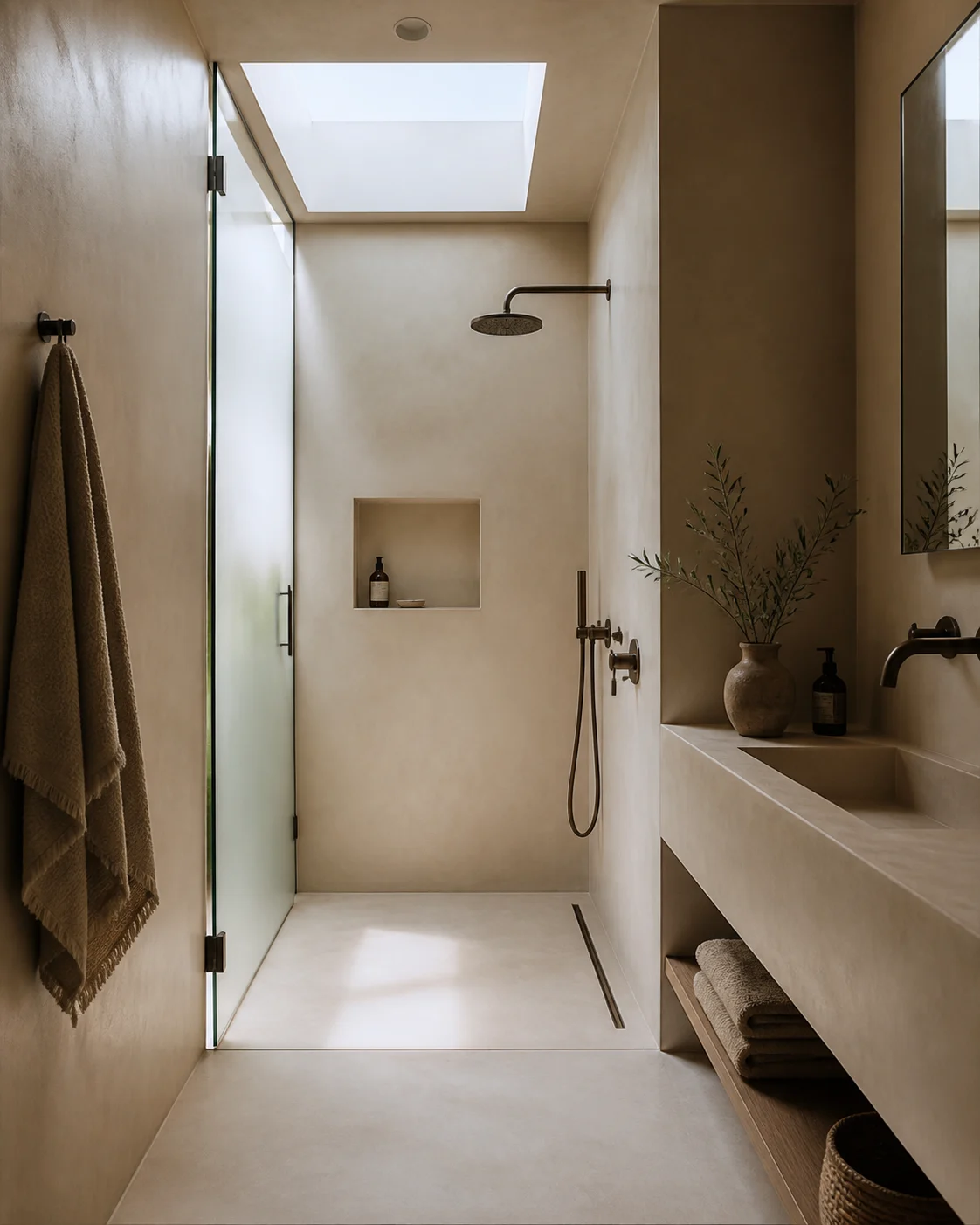
- Bathrooms with frosted-glass panels or skylights that admit diffuse UV
Medium priority — UV-stable is still the right call:
- Standard residential living rooms (indirect daylight adds up over decades)
- Bathrooms with frosted-glass panels that admit diffuse UV
- Hospitality spaces (long operating hours, mixed lighting)
Low priority — but still worth having:
- Basements and windowless rooms
- Interior hallways, closets, pantries
Translation: in a typical residential install, UV stability of the topcoat matters somewhere in your project. Picking a cheaper aromatic-polyurethane-sealed system because "my bathroom doesn't get sun" can still create a problem if the same finish runs into a kitchen, living room, or sunlit hallway. The polyurethane system in the same house should be consistent top to bottom — and it should use a UV-stable topcoat.
The question to ask before you sign
Print this one. Literally one question:
"Is the topcoat a two-component aliphatic polyurethane, and can you send me the TDS?"
The answer tells you everything:
- "Yes, it's aliphatic polyurethane, here's the TDS" → you're likely dealing with a legitimate premium microcement system. The TDS will confirm non-yellowing / UV-resistant and will list the chemistry.
- "It's polyurethane but I'm not sure if it's aromatic or aliphatic" → they're a reseller, not an installer. Push for the manufacturer's TDS.
- "It's an acrylic sealer, faster drying and cheaper" → that's an acrylic-cement system with an acrylic topcoat. Expect dullness and some chalking within 2–3 years in any sunlit room.
- "We apply a clear epoxy over the finish for durability" → the epoxy layer can introduce the yellowing problem the topcoat is supposed to prevent. Walk.
- "It's our proprietary sealer, we don't share the TDS" → that's your answer. No real manufacturer treats the topcoat chemistry as a trade secret.
Thirty seconds of conversation. Saves you a decade of disappointment.
ATRIA's position
We make UV-stable polyurethane topcoats because that's what a premium Italian microcement system requires. Specifically, Atriapol Antibacterial:
- Two-component water-dilutable polyurethane finish
- Non-yellowing and UV-resistant (per TDS, revision October 2025)
- Hard-elastic, closed-pore film
- Wet abrasion resistance > 10000 (DIN 53778)
- Taber abrasion 51 mg (CS17, 1000g, 1000 revolutions, EN ISO 5470-1)
- Adhesion to direct traction > 3.6 MPa (EN 1542, rigid system with traffic)
- Capillary absorption 0.052 kg/m²·h^0.5 (EN 1062)
- Operating temperature -10°C to +100°C
- ISO 22196:2011 antibacterial certification (against E. coli and Staphylococcus aureus)
Applied over a SuperTitanium BC or Titanium decorative coat, this is what protects the warm-greige, the soft dove-grey, or the creamy milk-white color you picked from our palette against the yellowing and hazing issues common to cheaper topcoat chemistries.
That outcome is deliberate — it's the chemistry behind the finish, not just the word "microcement" on a product label.
FAQ
Does microcement yellow over time?
Properly formulated polyurethane-mineral microcement sealed with a UV-stable two-component polyurethane topcoat is specified as non-yellowing. Epoxy-based microcement systems and microcement sealed with aromatic polyurethane or cheaper acrylic topcoats can yellow under UV exposure, sometimes within 18–24 months. The yellowing behavior depends on the topcoat chemistry, not on whether the product is called microcement.
What's the difference between microcement and epoxy flooring?
Microcement is a cementitious coating — cement or mineral filler bound with polymer resin — applied at 2–3 mm thickness by trowel. Epoxy flooring is a pure thermosetting resin poured as a self-leveling finish. They look superficially similar as seamless floors but perform very differently. Epoxy is known to yellow under UV; properly sealed polyurethane-mineral microcement is not.
Is polyurethane microcement UV-stable?
Yes — when the topcoat is a UV-stable aliphatic polyurethane. Aliphatic polyurethane is far less prone to UV yellowing than epoxy or aromatic polyurethane. ATRIA's Atriapol Antibacterial topcoat is specifically formulated to be non-yellowing and UV-resistant.
Will my microcement floor yellow in a sun-facing room?
It depends on the system. With a UV-stable aliphatic polyurethane topcoat, the finish is specified to hold tone under normal interior daylight exposure. With an aromatic polyurethane topcoat or an acrylic sealer, visible yellowing is more likely within 2–5 years depending on UV intensity.
Will my microcement hold color in a south-facing, sun-lit interior?
Yes, when the topcoat is aliphatic polyurethane. ATRIA's PURO system with Atriapol Antibacterial is specified for interior walls and floors, including high-UV interior applications like south-facing rooms, sunrooms, open-plan kitchens with skylights, and commercial retail with large storefront glazing.
Why do some microcement finishes yellow while others don't?
Three reasons, in order of commonality: the topcoat is aromatic polyurethane or acrylic rather than aliphatic polyurethane; the microcement binder is epoxy-modified rather than polyurethane; or the installer applied a clear epoxy finish on top of the microcement for extra protection. All three are chemistry errors, not microcement errors.
Is ATRIA microcement considered non-yellowing?
Yes. Our PURO system pairs polyurethane-mineral microcement with our two-component UV-resistant polyurethane topcoat, Atriapol Antibacterial. The TDS confirms UV-resistant and non-yellowing behavior.
Further reading
- The best polyurethane microcement: why formulation matters more than brand
- Microcement cost per square foot: full 2026 pricing guide
- Microcement vs tile: which is right for your bathroom?
- Microcement vs epoxy: full comparison
- What is microcement? A complete guide
- PURO microcement system — full product spec
About the author
Enzo Atria
Owner & 2nd-generation lead, Colorificio Atria S.r.l. · Partanna, Sicily
Enzo leads Colorificio Atria, the Italian manufacturer behind the PURO polyurethane-mineral microcement system and the VENEZIANO Venetian plaster collection. Over two decades he has built ATRIA into one of Europe's reference-standard microcement houses, with specification work in luxury residential, hospitality, and healthcare across Italy, the Middle East, and — more recently — the US through ATRIA USA. He oversees formulation, QC, and the certified installer training program out of the Partanna facility.
LinkedIn →