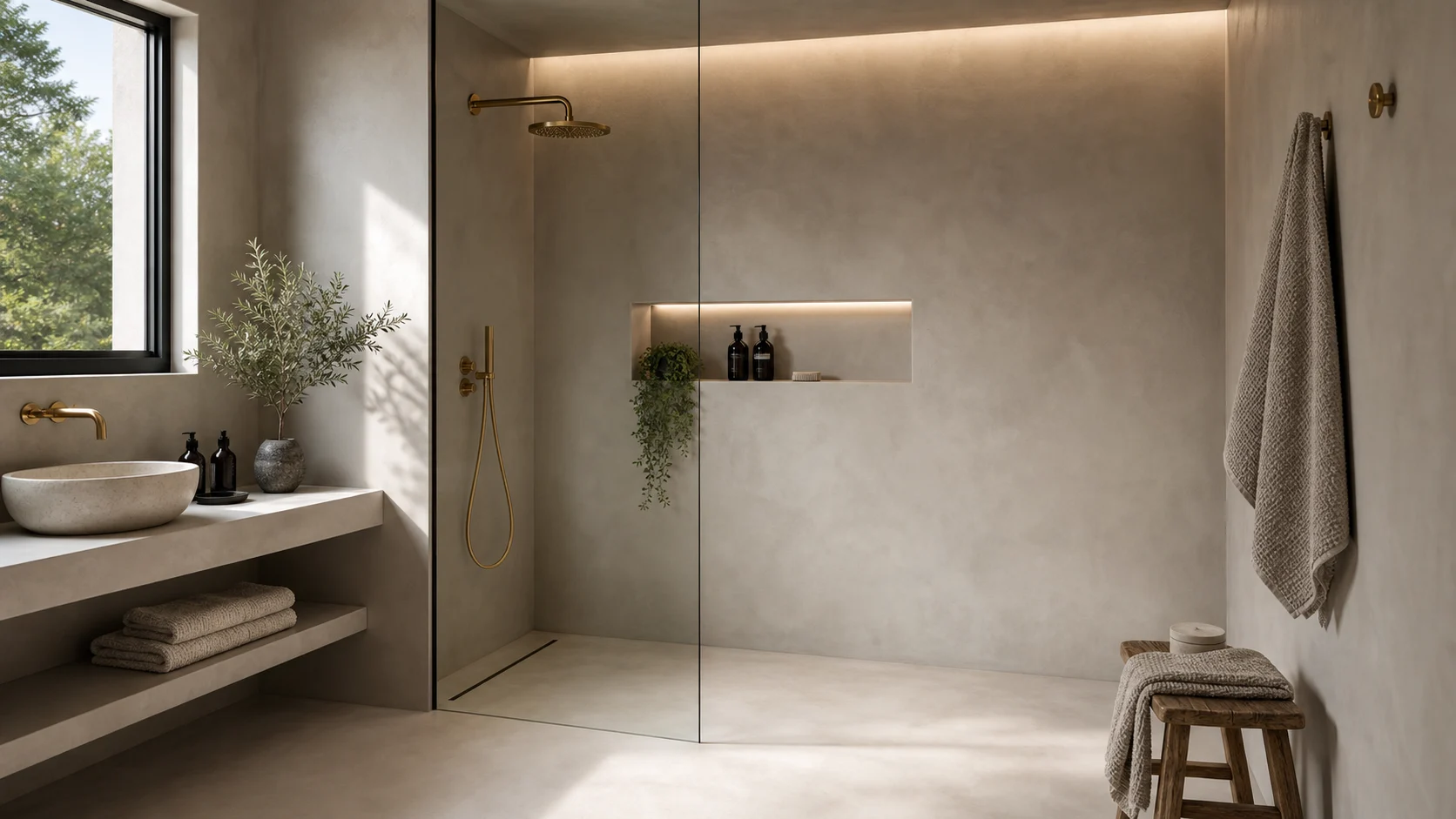
Yes, microcement can be used in showers. But the important word is system. A shower is not a decorative wall. It is a direct-water environment with drains, corners, movement, steam, cleaning chemicals, and daily use. Microcement performs beautifully there when the waterproofing, substrate prep, reinforcement, finish coat, and topcoat are specified together.
ATRIA position: for showers and wet rooms, we recommend a proper waterproofing system first, then ATRIA polyurethane microcement over it. Our preferred finish for wet areas is SuperTitanium BC, sealed with Atriapol. This gives the client a seamless, grout-free surface without relying on the decorative coating as the waterproofing layer.
The short answer for homeowners
If you are asking whether a microcement shower is possible, the answer is yes. If you are asking whether any microcement product can simply be troweled over a shower wall and exposed to water, the answer is no. The difference is the wet-area assembly underneath and around it.
A correct shower build starts with the substrate and waterproofing. The microcement is the visible finish. It creates the seamless look, color, texture, and daily-use surface. The waterproofing system beneath it protects the structure.
That waterproofing layer should be specified like any other shower assembly: compatible with the substrate, drain, corners, wall-to-floor transitions, local requirements, and expected water exposure. ATRIA can help clients and installers choose the right wet-area direction, but the shower still needs a real waterproofing system before the finish work begins.
What a proper microcement shower system includes
Waterproofing
The shower waterproofing system belongs under the microcement finish.
Use a code-compliant shower waterproofing membrane or liquid-applied waterproofing system selected for the substrate and local requirements.
Primer
Primerquarz or Atriafloor Primer BC creates adhesion, depending on the substrate.
Tile, concrete, backer board, and other substrates need different preparation.
Reinforcement
Fiberglass mesh helps control movement and cracking in bathroom assemblies.
For shower walls, corners, transitions, and mixed substrates, reinforcement matters.
Microcement
SuperTitanium BC is the preferred ATRIA finish for showers and wet areas.
It is a two-component polyurethane microcement with high mechanical resistance.
Topcoat
Atriapol seals the finished surface and makes it practical for daily cleaning.
Wet-area work should be sealed as a full system, not treated like a decorative wall.
This is why a microcement shower should be planned before installation starts. The bench, niche, curb, drain, slope, corners, and wall-to-floor transitions all need to be included in the wet-area specification. If those details are handled casually, the finish may look good for a few weeks and fail later.
Why polyurethane microcement is the wet-area choice
ATRIA recommends polyurethane microcement for showers because wet areas need more than a beautiful cement look. They need a hard-elastic finish, high mechanical resistance, and compatibility with protective polyurethane topcoats. SuperTitanium BC is our preferred wet-area finish because it is a two-component polyurethane microcement used for bathrooms, showers, commercial floors, showrooms, offices, and tile renovation.
Standard decorative coatings may be fine for dry feature walls. A shower is different. Water is constant, cleaning is more frequent, and movement around corners and drains is less forgiving. The product choice and build sequence need to reflect that.
Shower floors need one more review point: slope, drain detail, and slip resistance. A finish can be appropriate for wet-area walls and still require project-specific review before it is used on a shower pan or floor.
| Question | Shower / Wet Area | Dry Decorative Area |
|---|---|---|
| Best use | Shower walls, wet rooms, tub surrounds, spa bathrooms | Dry walls, powder rooms, decorative residential walls |
| Recommended finish | SuperTitanium BC | Titanium or other decorative finishes, depending on surface |
| Waterproofing under finish | Required | Usually not required unless exposed to water |
| Reinforcement | Recommended or mandatory in wet-area assemblies | Depends on substrate and movement risk |
| Topcoat | Atriapol wet-area sealing system | Atriapol when washability or protection is needed |
| Installer skill | High - this should be treated as a system spec | Moderate to high depending on finish |
| Shower floor caution | Slope, drain detail, and slip resistance must be reviewed | Not applicable |
The mistakes that cause shower failures
- •Treating microcement as a replacement for the waterproofing membrane.
- •Skipping substrate prep because the surface looks clean.
- •Using a decorative wall system in a shower instead of a wet-area system.
- •Leaving corners, niches, benches, and drains to be solved at the end.
- •Using the wrong primer for tile, cement board, concrete, or mixed substrates.
- •Under-sealing the finish or rushing cure times before water exposure.
Most problems blamed on microcement are actually specification or installation problems. The wrong primer, trapped moisture, a moving substrate, unreinforced corners, or incomplete waterproofing can defeat even a good product. That is why ATRIA treats shower work as a complete system rather than a single bucket purchase.
Cure time is another common failure point. Dry-to-touch is not the same as ready for daily water exposure. ATRIA technical education lists Atriapol full cure at 7 days before heavy use, so shower scheduling should be planned around full cure and current TDS guidance, not around when the surface first feels dry.
Can microcement be installed over an existing shower?
Sometimes. Existing tile can be a good substrate only when it is solid, clean, properly bonded, and not hiding a water problem. If grout is failing, tile is hollow, the shower pan is leaking, or the wall assembly is compromised, microcement should not be used as a cosmetic cover-up.
When the existing surface is sound, a professional installer can prepare it with the correct mechanical profile, primer, reinforcement where needed, and the full wet-area microcement cycle. When the existing waterproofing is questionable, the right move is to rebuild or re-waterproof first.
Steam showers and tightly enclosed wet rooms deserve extra caution. Ventilation, heat, condensation, and cure conditions all affect performance. For those spaces, ATRIA recommends a project-specific specification rather than treating the shower like a standard residential tub surround.
What we recommend at ATRIA
For clients planning a shower, tub surround, or wet room, our recommendation is straightforward:
- Confirm the substrate and water exposure before choosing products.
- Use a dedicated shower waterproofing system before the decorative finish.
- Use SuperTitanium BC for the wet-area microcement finish.
- Use reinforcement in corners, transitions, and movement-prone surfaces.
- Seal with Atriapol and respect cure times before water exposure.
- Use a trained applicator for full shower work.
Planning a microcement shower?
Send us the project photos, room dimensions, and current substrate. We will help you determine whether the space needs a standard wet-area system, a full build, or installer support.
Frequently asked questions
Can microcement go directly over shower tile?
Sometimes, but only if the tile is sound, properly prepared, and the shower waterproofing condition is understood. Loose tile, failed grout, hidden leaks, or movement need to be corrected before any microcement system is installed.
Is SuperTitanium BC better than standard microcement for showers?
Yes. For ATRIA wet-area work, SuperTitanium BC is the preferred choice because it is a two-component polyurethane microcement used in bathrooms, showers, commercial floors, and higher-wear areas when it is installed as part of the correct system.
Can a homeowner DIY a microcement shower?
A small decorative wall is one thing. A shower is different. Direct-water exposure, drains, corners, niches, benches, and substrate movement make this a professional system application. ATRIA recommends certified installer support for shower work.
Does microcement need grout in a shower?
No. That is one of the main reasons clients choose it. A properly installed shower can have a continuous grout-free look across walls, benches, niches, and floors.