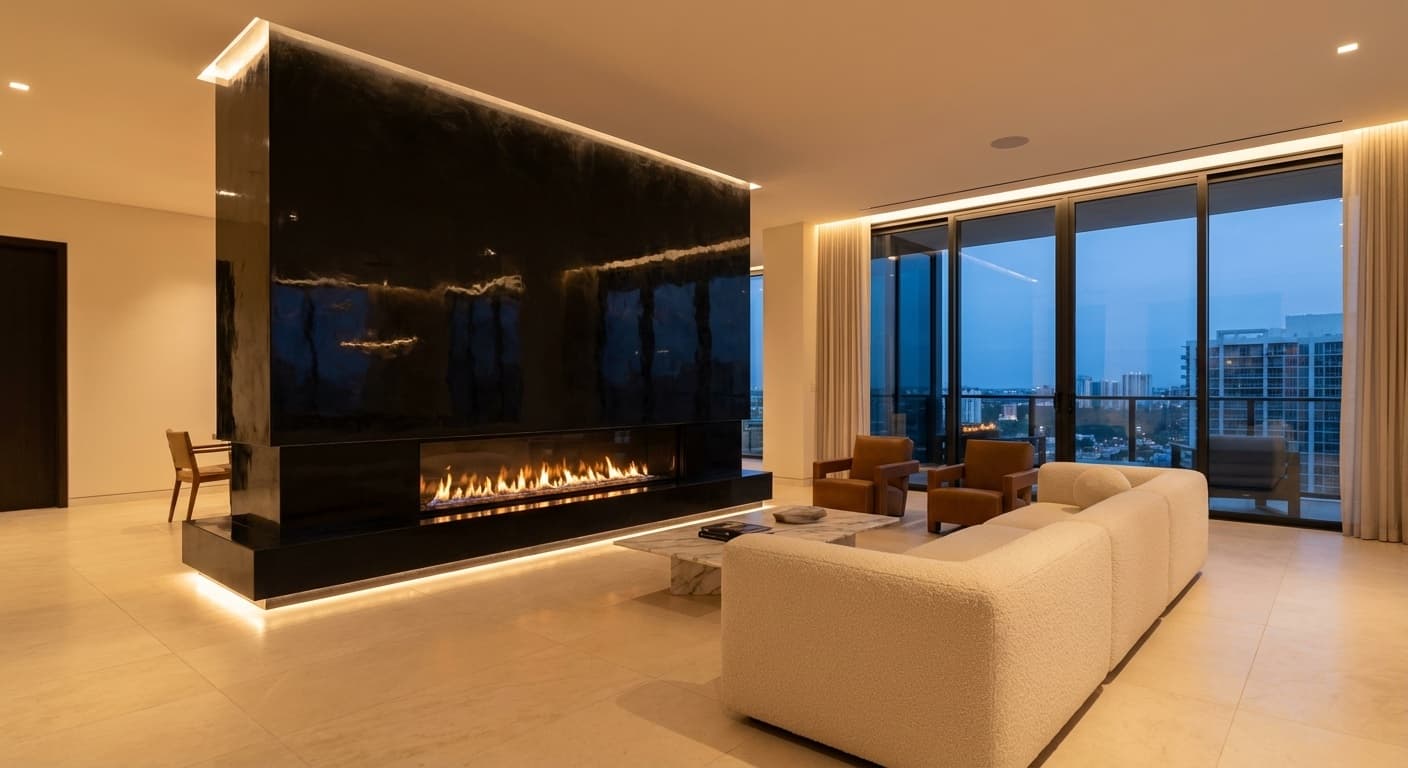
In premium interiors, paint is no longer the only default. Across hospitality, luxury residential, and boutique commercial projects, designers are increasingly choosing plaster-based wall finishes for richer texture, better aging characteristics, and stronger emotional impact.
The conversation around venetian plaster vs paint is really a conversation about short-term convenience vs long-term value. Paint is fast and affordable. Venetian plaster is slower and more artisanal—but can deliver exceptional depth, durability, and visual distinction.
Below, we break down the most important decision factors so you can choose the right finish for your project goals.
Visual Impact: Flat Color vs Luminous Depth
Paint creates a uniform film. Even premium paints—with better pigment, washability, or matte quality—are still fundamentally a flat coating that sits on top of the wall. In many projects that is exactly what you want: a clean, quiet, predictable backdrop.
Venetian plaster behaves differently. It is built in nuanced layers and finished by hand, producing mineral depth and subtle movement. Light interacts with the surface throughout the day, giving walls a sense of softness and life that flat coatings rarely achieve.
This is one major reason designers switch: when clients ask for “quiet luxury,” “old-world warmth,” or “boutique hotel texture,” venetian plaster consistently delivers what paint cannot.
Longevity: Why Plaster Often Outlasts Paint
In active households and commercial spaces, interior paint can begin to show wear quickly—especially in hallways, stairwells, entry zones, and high-touch areas. Depending on product and use, full refreshes are commonly needed every 3 to 7 years.
Venetian plaster, especially lime-based formulations, is known for long service life when properly specified and maintained. Instead of feeling “used up” after a few years, plaster often develops a more natural patina that many clients find desirable.
This longer performance horizon is central to the designer shift: projects aiming for enduring quality are moving away from recurring repaint cycles and toward more permanent wall systems.
Venetian Plaster vs Paint: At-a-Glance Table
| Feature | Venetian Plaster | Paint |
|---|---|---|
| Visual depth | Layered, luminous, mineral movement that changes with light | Uniform film finish with limited depth |
| Expected lifespan | 15–25+ years with proper care | 3–7 years before noticeable refresh need |
| Maintenance | Low routine maintenance, occasional refresh | Frequent touch-ups and periodic full repainting |
| Upfront cost | Higher professional artisan cost | Lower initial spend |
| Long-term ROI | Strong over longer ownership horizons | Higher cumulative repaint cycles over time |
| Sustainability profile | Mineral/lime-based options with low VOC potential | Varies widely by formulation and resin system |
| Installation complexity | High-skill trowel craft, multi-coat process | Fast and familiar application |
Cost and ROI: Looking Beyond Upfront Price
Paint almost always wins on initial cost. Material is inexpensive, labor is familiar, and schedules are short. Venetian plaster is a specialty finish, so labor skill and time increase upfront investment.
Why ROI can favor venetian plaster
- Fewer full refresh cycles over long ownership periods.
- Higher perceived design value in premium market segments.
- Greater differentiation for resale and hospitality branding.
- Lower disruption compared with repeated repaint projects.
For design-led homes, boutique hotels, and high-end retail, wall finish is part of brand language. Venetian plaster frequently returns value through stronger first impressions and visual memorability.
Explore ATRIA’s venetian plaster systems and request specification support for your project scope.
Maintenance: Day-to-Day Reality
Paint maintenance is familiar: spot touch-ups, scuff cleanup, and eventual full repainting. The process is manageable but recurring. In busy interiors, this can become a predictable operating cost.
Venetian plaster maintenance is typically low when the correct finish and protection strategy are used. Regular gentle cleaning and occasional professional refresh can keep surfaces looking premium for years.
The practical benefit for owners is reduced repaint churn—fewer “starting over” moments and a more stable wall finish over time.
Environmental Benefits and Health Considerations
Sustainability conversations increasingly shape finish selection. Many venetian plasters are mineral or lime based, with naturally breathable characteristics and low-VOC potential depending on the full system used.
Paint ranges widely: some products are low-VOC and durable, while others rely on heavier synthetic resin chemistry. Because product performance and emissions vary by line, it is important to compare technical data sheets rather than category labels.
If indoor air quality and material longevity are top priorities, venetian plaster can offer a compelling path—particularly when paired with responsible specification and skilled installation.
Installation Process: What to Expect
Venetian Plaster Process
- Surface assessment, prep, and bonding strategy
- Multiple trowel-applied coats for depth and movement
- Compression/burnishing to shape final character
- Optional protective treatments depending on use area
- Skill-intensive finishing and quality control
Paint Process
- Masking and substrate prep
- Primer where required
- One or two finish coats depending on product coverage
- Touch-up and cleanup
- Short schedule and straightforward logistics
The key tradeoff is speed versus craftsmanship. Paint is fast and efficient. Venetian plaster rewards patience with a finish that reads as bespoke rather than standard.
When Designers Recommend Venetian Plaster
- Statement spaces where mood and depth matter (entries, living rooms, dining rooms).
- Luxury renovations where long-term finish quality is the priority.
- Hospitality environments seeking elevated, memorable interiors.
- Projects aligned with natural-material and low-VOC goals.
- Homes where repeated repainting is a long-term pain point.
See ATRIA’s completed venetian plaster projects to evaluate finish styles, sheen levels, and spatial applications.
FAQ: Venetian Plaster vs Paint
Is venetian plaster worth it compared to paint?
For projects focused on design impact and long-term value, yes. Upfront cost is higher, but many owners find the longevity and aesthetic return justify the investment.
Can venetian plaster be used over existing painted walls?
Often yes, with the correct preparation and bonding approach. A qualified applicator should evaluate adhesion, substrate integrity, and moisture conditions before work begins.
Is paint always cheaper in the long run?
Not necessarily. Paint is cheaper at install, but repeated repaint cycles can close the gap over time, especially in high-traffic or high-end spaces.
The Bottom Line
In the venetian plaster vs paint decision, paint remains the pragmatic short-term option. Venetian plaster is the strategic long-term finish for clients who want depth, permanence, and elevated design character. That’s why so many designers are making the switch. If you're comparing material stacks, review ATRIA's wall system sets for planning and budgeting.